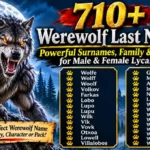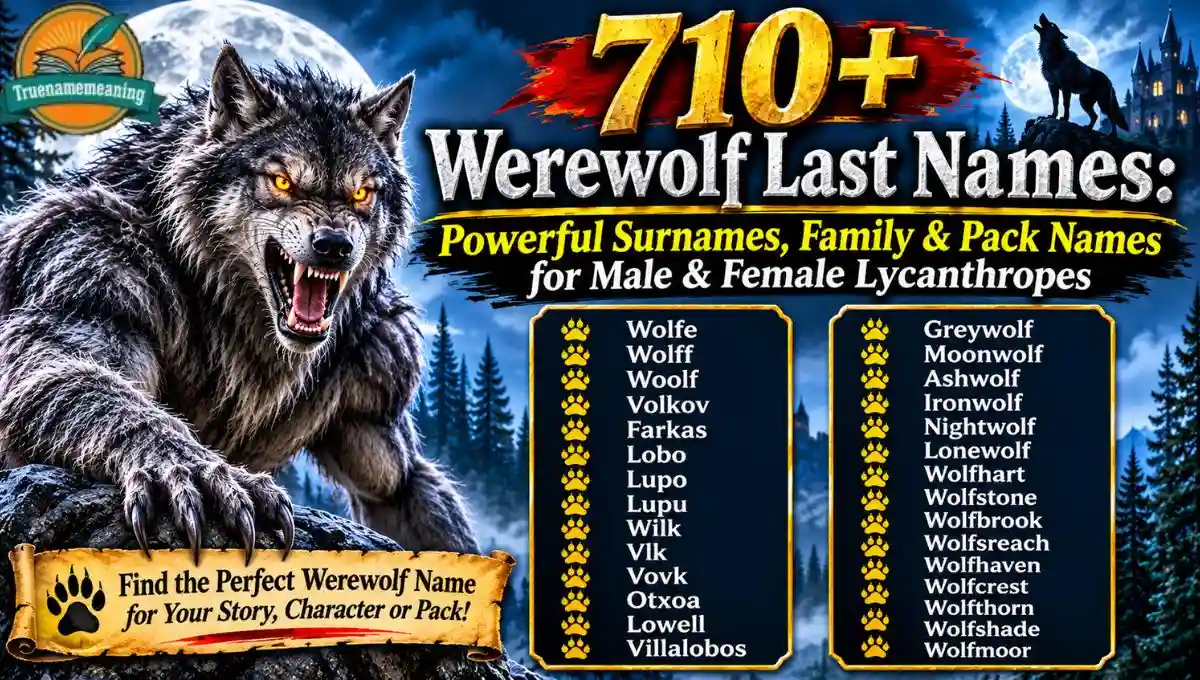
A memorable werewolf character needs more than a fierce first name. The right surname can suggest an ancient family, a hidden identity, a powerful alpha, or a pack that has guarded its territory for generations.
Whether you’re creating a fantasy novel, a Dungeons & Dragons character, a role-playing game identity, or a supernatural romance, Werewolf Last Names can help give your character a stronger identity.
This collection includes male and female surnames, old family names, wolf-inspired meanings, alpha titles, gothic choices, funny options, mythology-inspired ideas, and names for entire packs and clans. You’ll also find real wolf-related surname roots and practical tips for creating an original name that fits your character’s history.
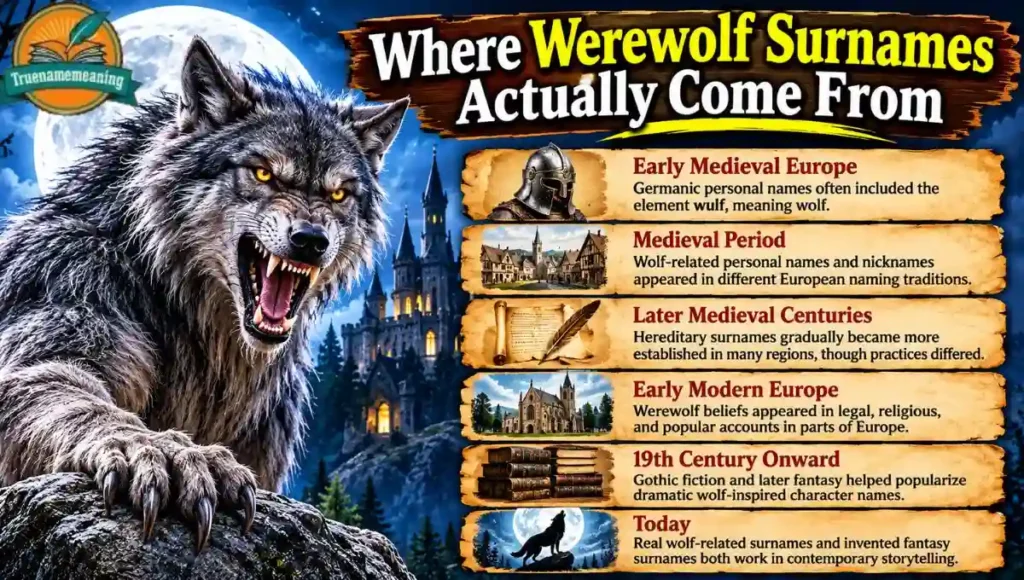
Where Werewolf Surnames Actually Come From
Werewolf surnames can draw inspiration from real family names, wolf-related words, landscapes, occupations, and fictional family histories. The strongest choices often combine a believable surname structure with a subtle reference to wolves, wilderness, moonlight, or survival.
In real naming traditions, wolf-related words appear in several languages. For example, Volkov comes from the Russian word volk, meaning wolf, while Farkas means wolf in Hungarian. Lupo is an Italian wolf-related surname, and Lobo is a Spanish and Portuguese nickname meaning wolf. These are real linguistic examples, not invented werewolf titles.
For fictional characters, you can use those roots directly or combine them with landscape words such as moor, wood, vale, and ridge. That gives you names that sound established without suggesting that every fantasy surname has a historical origin.
A Quick Timeline of Wolf-Rooted Surnames
| Period | Naming background |
| Early medieval Europe | Germanic personal names often included the element wulf, meaning wolf. |
| Medieval period | Wolf-related personal names and nicknames appeared in different European naming traditions. |
| Later medieval centuries | Hereditary surnames gradually became more established in many regions, though practices differed. |
| Early modern Europe | Werewolf beliefs appeared in legal, religious, and popular accounts in parts of Europe. |
| 19th century onward | Gothic fiction and later fantasy helped popularize dramatic wolf-inspired character names. |
| C | Real wolf-related surnames and invented fantasy surnames both work in contemporary storytelling. |
The Old English name Wulfstan, for example, combines wulf (wolf) and stan (stone). Medieval Germanic names also used wolf elements, and academic research discusses how frequently these elements appeared in early European personal names.
One important distinction: an old wolf-related personal name is not automatically proof of an ancient werewolf family. A fictional bloodline can borrow from historical naming patterns, but its supernatural history belongs to your story.
Werewolf Naming Traditions: Fiction vs. Folklore
Traditional werewolf stories and modern fantasy use names in different ways. Folklore often places a transformation within an ordinary human life, while contemporary fiction frequently gives packs, clans, and supernatural families distinctive names that help readers understand their world.
Historical werewolf traditions appear in ancient stories and medieval literature. The Greek story of Lycaon is one well-known mythological connection, while the medieval tale Bisclavret presents a werewolf figure in a different narrative tradition.
For a folklore-inspired character, a familiar surname such as Miller, Baker, Hayes, or Turner may be more effective than an elaborate fantasy title. An ordinary name can make a supernatural secret feel more believable.
Modern fantasy gives writers more room to use symbolic surnames. Names such as Ashvane, Ironcrest, and Moonhollow can suggest a family’s territory, reputation, or supernatural history before the character even speaks.
You can also give a character two identities:
- Public surname: The ordinary family name used at school, work, or in everyday human society.
- Pack name: A title or inherited name recognized within the supernatural community.
- Bloodline name: The surname connected to the family’s ancestry and history.
- Earned name: A name gained after a major victory, transformation, or act of loyalty.
This approach makes your Werewolf Last Names more meaningful because each name has a clear purpose in the story.
What Makes a Great Werewolf Last Name?
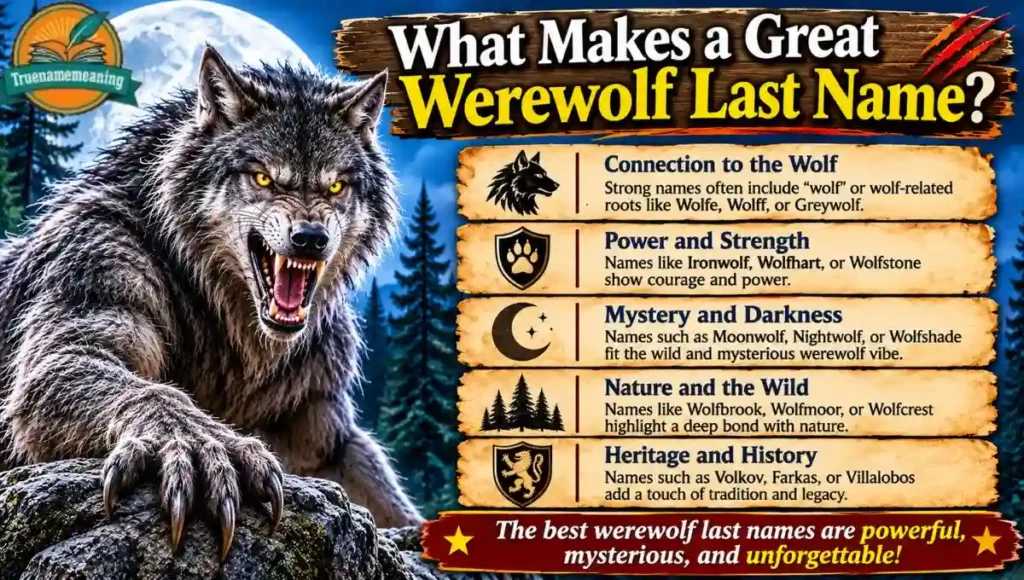
A strong surname should sound natural, suit the character, and fit the setting. The best Werewolf Last Names do not always need words such as fang, claw, or wolf; sometimes a quiet reference to a forest or mountain creates a more memorable identity.
1. It works as a real surname first
Try to choose a name that could belong to an ordinary person. Ashford, Blackwell, Holloway, and Winterfield have familiar surname structures, making them suitable for modern fantasy and paranormal romance.
2. It tells you something about territory or lineage
A surname can hint at where a family originated. Frostvale suggests a cold mountain region, while Thornwood brings to mind a dense forest. A name like Riverstone could belong to a family whose ancestors guarded a crossing.
3. It pairs cleanly with almost any first name
Say the full name aloud before choosing it. Maya Greymoor, Ethan Ashford, and Lucas Thornvale each have a different rhythm, but the surnames remain easy to pronounce.
4. It doesn’t repeat the first name’s energy
Avoid combinations that feel overloaded. A character named Fang Wolfclaw may sound less convincing than Fang Blackwood or Ronan Greymane. Use one strong image rather than repeating the same idea.
5. It sounds right shouted across a battlefield or a classroom, either one
A character’s name should work in ordinary dialogue as well as dramatic scenes. Mason Vane sounds believable in a school setting, while Mason Ironfang may suit a more stylized fantasy world.
6. It has a story if you ask it one question
Ask why the family received its surname. Did its ancestors protect a forest? Did they survive a winter that destroyed their village? Did an early alpha earn the name after defending the pack? A short backstory can turn a simple name into part of your worldbuilding.
Male Werewolf Last Names
Male Werewolf Last Names often use firm consonants, compact sounds, and references to strength or territory. These options can suit an alpha, a warrior, a lone wolf, or a character who is still earning a place in the pack.
| Name | Suggested character style |
| Ironcrest | Strong, disciplined leader |
| Ashfang | Battle-tested survivor |
| Wolfhart | Loyal protector |
| Stormvale | Adventurous wanderer |
| Blackthorn | Quiet and intimidating |
| Greywarden | Responsible pack guardian |
| Frostclaw | Cold-weather hunter |
| Thornridge | Territorial warrior |
| Vanecrest | Noble family heir |
| Nightford | Mysterious outsider |
| Redmarrow | Fierce rival |
| Stonehowl | Powerful pack member |
| Darkwell | Secretive character |
| Wolfsbane | Dangerous and feared |
| Ravenholt | Clever strategist |
| Grimwood | Old-fashioned and stern |
| Flintmoor | Tough survivor |
| Bloodmere | Dark fantasy character |
| Stormholt | Confident alpha |
| Ashbourne | Traditional family heir |
| Wolfenden | Contemporary character |
| Dreadmoor | Fearsome antagonist |
| Frostwick | Reserved and watchful |
| Thornfield | Grounded and practical |
| Greyhaven | Protective leader |
More Werewolf Last Names include Rookvale, Ironwood, Blackridge, Fenwick, Wolfstone, Duskford, Crowhurst, Ashcombe, Wintermark, and Hollowcrest. These names are fictional suggestions unless otherwise identified as real surnames.
For a modern setting, try Evan Blackwell, Noah Ashford, or Daniel Wolford. For a darker fantasy setting, Kael Dreadmoor, Ronan Ironcrest, and Darian Frostclaw create a more dramatic impression.
Female Werewolf Last Names
Female Werewolf Last Names can sound graceful, fierce, mysterious, or commanding. Rather than relying on stereotypical soft endings, choose a surname that reflects the character’s personality, pack role, and family history.
| Name | Suggested character style |
| Silverwynd | Moonlit and mysterious |
| Moonvale | Calm and thoughtful |
| Roseclaw | Gentle but fearless |
| Frostmere | Reserved and elegant |
| Sablethorn | Dark and independent |
| Wrenwood | Nature-loving character |
| Ashlark | Clever and adventurous |
| Ravencrest | Noble and confident |
| Winterglen | Quiet and observant |
| Thornveil | Secretive spellcaster |
| Emberwyn | Passionate and brave |
| Nightbloom | Mysterious outsider |
| Willowfang | Protective and loyal |
| Starhollow | Dreamer or seer |
| Silvermoor | Ancient family heritage |
| Duskwillow | Soft-spoken strategist |
| Briarstone | Determined survivor |
| Mooncrest | Pack leader’s daughter |
| Frostwhisper | Patient and intelligent |
| Rosehaven | Kind-hearted guardian |
| Shadowmere | Independent warrior |
| Fernwick | Practical and grounded |
| Stormlily | Bold and energetic |
| Ravenfield | Sharp-minded leader |
| Dawnthorn | Hopeful and resilient |
Other options include Elowen Blackwood, Mara Wintervale, Selene Ashgrove, Lyra Thornfield, and Nora Greymoor. Pair the surname with a first name that creates a natural rhythm.
A strong female character does not need a delicate surname, just as a gentle male character does not need a harsh one. Choose a name based on personality rather than assuming that every woman in a pack should have a softer family identity.
Werewolf Family Names
Werewolf Family Names should feel as if they have passed through several generations. They can represent an ancestral home, a founding pack, a family promise, or a reputation that younger members are expected to protect.
| Family name | Fictional family identity |
| Ashford | Family from a settlement near an old crossing |
| Greymane | Respected elders and traditionalists |
| Blackwell | A family known for secrecy |
| Wintermoor | Ancestral home in a cold region |
| Thornwood | Forest guardians |
| Ravenwood | Watchful and strategic bloodline |
| Ironvale | A disciplined warrior family |
| Hollowmere | Family tied to a hidden lake |
| Stormridge | Mountain-dwelling ancestors |
| Silverbrook | A peaceful but influential lineage |
| Duskwood | Family with a mysterious past |
| Redfern | Woodland hunters |
| Stonehaven | Protectors of an old settlement |
| Frostbourne | Northern family heritage |
| Nightwell | Secretive supernatural lineage |
| Emberfield | Descendants of survivors |
| Crowhurst | Family with a reputation for intelligence |
| Moonridge | A family associated with lunar rituals |
| Blackthorn | A proud and stubborn bloodline |
| Wolfsden | A family whose identity centers on pack loyalty |
A family name can be different from a pack name. For example, the Ashford family might belong to the Silverbrook Pack, while the ruling Greymane family leads the group. This distinction helps readers understand relationships and power structures.
For a large fictional family tree, decide whether surnames pass through one parent, both parents, or a pack-specific tradition. You can also create a custom rule in which a family name changes after exile, adoption, or a major leadership event.
Werewolf Surnames With Meaning
Meaningful Werewolf Last Names can be built from real linguistic roots or invented combinations. The table separates established wolf-related names from fictional suggestions so readers can tell the difference.
| Surname | Meaning or inspiration |
| Wolf | Real surname connected to the animal or a personal-name element |
| Wolfe | English variant of Wolf |
| Volkov | Russian surname derived from volk, meaning wolf |
| Farkas | Hungarian word and surname meaning wolf |
| Lupo | Italian wolf-related surname |
| Lupu | Romanian surname derived from lup, meaning wolf |
| Lobo | Spanish and Portuguese wolf-related nickname |
| Wilk | Polish surname meaning wolf |
| Vlk | Czech and Slovak word for wolf; also used in surnames |
| Vovk | Ukrainian and Slovene wolf-related surname |
| Otxoa | Basque name derived from a word meaning wolf |
| Lowell | Surname connected to a Norman French wolf-related nickname |
| Ashfang | Fictional name suggesting survival and strength |
| Frostvale | Fictional name suggesting a cold homeland |
| Moonhollow | Fictional name linked to a secluded lunar setting |
| Ironcrest | Fictional name suggesting resilience and status |
| Thornwood | Fictional landscape-based surname |
| Nightwell | Fictional name suggesting hidden history |
| Stormrend | Fictional compound suggesting a family shaped by conflict |
| Greymoor | Fictional landscape-based surname |
The real Werewolf Last Names examples above are supported by surname references that document wolf-related meanings and origins.
Do not assume that a name has a real historical meaning simply because it resembles a foreign word. If you invent Moonhollow or Stormrend, describe its meaning as part of your fictional world rather than presenting it as a verified translation.
Wolf Last Names
Wolf Last Names are useful when you want a character to have a believable surname with a direct or indirect connection to wolves. Some are genuine surnames, while others are creative options for fantasy characters.
Real wolf-related surname ideas:
- Wolf
- Wolfe
- Wolff
- Woolf
- Volkov
- Farkas
- Lobo
- Lupo
- Lupu
- Wilk
- Vlk
- Vovk
- Otxoa
- Lowell
- Villalobos
Fictional wolf-inspired surnames:
- Greywolf
- Moonwolf
- Ashwolf
- Ironwolf
- Nightwolf
- Lonewolf
- Wolfhart
- Wolfstone
- Wolfbrook
- Wolfsreach
- Wolfhaven
- Wolfcrest
- Wolfthorn
- Wolfshade
- Wolfmoor
For a contemporary American setting, a real surname such as Wolfe or Wolf may blend naturally into everyday life. For a fantasy setting, a compound like Wolfshade can make the supernatural connection more obvious.
Lycanthrope Names
The word lycanthrope refers to a person or creature associated with werewolf transformation. It comes from Greek elements commonly translated as wolf and human. It is a useful term when your fictional setting has a formal, academic, or historical approach to shapeshifting.
These Lycanthrope Names are designed for characters whose condition is studied, hidden, or tied to an old family record.
| Name | Suggested tone |
| Aldenford | Formal and traditional |
| Corvinshire | Old-world and mysterious |
| Dorianvale | Refined and reserved |
| Elricworth | Noble family heritage |
| Haldenmoor | Scholarly and serious |
| Torvencrest | Ancient bloodline |
| Caelbourne | Elegant and secretive |
| Varrington | Established family |
| Morvenhall | Gothic and historic |
| Wystanford | Traditional and restrained |
| Adricwell | Contemporary fantasy |
| Norwicke | Old family estate |
| Bertramvale | Academic and formal |
| Ossricmere | Mysterious lineage |
| Ilarioncroft | Unusual and aristocratic |
| Corvenholt | Dark woodland heritage |
| Dorianhollow | Hidden family history |
| Elricfen | Marshland origin |
| Aldermere | Quiet and established |
| Varrowick | A family with secrets |
These are invented fantasy surnames, not verified historical lycanthrope family names. Use them for a medical archive, secret society, supernatural research institute, or family that has documented its transformations for centuries.
Read More: 599+ Insane Anime Usernames That Are Seriously Cool
Alpha & Pack Leader Surnames
An alpha’s surname should suggest authority without sounding like a title. These Alpha Werewolf Names work for leaders, founding families, respected elders, and rivals competing for control of a territory.
- Ironbane
- Highcrest
- Warhowl
- Kingsward
- Stormcrown
- Dreadmane
- Bloodcrest
- Primevale
- Elderthorn
- Crownfang
- Stonewarden
- Greysovereign
- Ironvane
- Thorncrown
- Wolfguard
- Nightwarden
- Stormborn
- Frostking
- Blackreign
- Ashwarden
- Grandhowl
- Silverthane
- Duskmarshal
- Warcrest
- Highmoor
- Fangwarden
- Crownholt
- Bloodward
- Firstmane
- Ironhowl
A leader named Rowan Ironvane might come from a family that has ruled for generations. A character named Mira Stormcrown could have earned her position after uniting rival groups.
In your story, decide whether alpha status is inherited, elected, challenged, or earned. The surname can remain unchanged even when leadership passes to another person, or the pack may adopt a new public title after a change in power.
Unique Werewolf Last Names for Fantasy Characters and Stories
Some stories need names that feel original without becoming difficult to pronounce. These unique Werewolf Last Names combine natural features, darker imagery, and traditional surname patterns.
- Aethermoor
- Briarvane
- Cinderholt
- Duskwarren
- Emberhollow
- Fenraven
- Gloamridge
- Hollowthorn
- Isenwood
- Juniperfang
- Kestrelmoor
- Larkhaven
- Mistvale
- Northglen
- Oakenfell
- Palecrest
- Quillthorn
- Rimewood
- Sableford
- Thundertree
- Umbervale
- Vesperholt
- Wildmere
- Yewstone
- Zephyrglen
These names suit fantasy novels, role-playing campaigns, supernatural games, and original character profiles. Before choosing one, search the name to see whether it is already strongly associated with another fictional character, brand, or published series.
Ancient Werewolf Bloodline & Legendary Family Surnames
Ancient bloodline names should carry a sense of history. They may be connected to a founding ancestor, an old territory, a family oath, or a legend that younger pack members still repeat.
- Elderwolf
- Fenraven
- Moonwarden
- Ashenvale
- Thorncairn
- Frostcrown
- Silverthorn
- Oldenmoor
- Wolfenshade
- Ravencrest
- Ironhollow
- Winterthane
- Bloodmere
- Stonehowl
- Greycloak
- Duskborne
- Hollowcrown
- Emberthane
- Nightwarden
- Stormhearth
- Blackfen
- Wolfsbane
- Cinderhall
- Thornwyck
- Moonspire
You can make these family names feel older by giving them a short origin story. Perhaps Moonwarden began with a family that protected a sacred meeting place, while Thorncairn belonged to guardians of a burial ground. These are fictional explanations, so you can adapt them to your world.
Dark & Gothic Werewolf Last Names
Dark Werewolf Last Names suit cursed families, gothic romances, mysterious villains, and characters who carry a difficult history. A little restraint often makes these names more effective than using frightening words in every part of a character’s identity.
- Shadowmere
- Grimthorne
- Nightgrave
- Blackhollow
- Wraithwood
- Duskveil
- Gravewell
- Ravenmourne
- Sablecrypt
- Hollowshade
- Ebonridge
- Gloomvale
- Cursedwell
- Blightmoor
- Thorncrypt
- Nightfall
- Grimwood
- Voidcrest
- Darkwater
- Ashenveil
- Wraithmoor
- Duskmourn
- Blackthorn
- Gallowmere
- Sablegrave
For a gothic romance, Elena Shadowmere or Adrian Blackhollow sounds dramatic without being too complicated. For a villain, Lord Varric Nightgrave may fit a darker fantasy setting.
Badass & Powerful Werewolf Last Names
Powerful Werewolf Last Names should sound forceful and memorable. They can be useful for rival alphas, battle-tested guardians, feared hunters, and characters whose reputation is known across several packs.
- Wrathborne
- Ironbreaker
- Stormcrusher
- Feralcrest
- Thunderfang
- Havocthorn
- Bloodreaver
- Warforge
- Skullwarden
- Furyvale
- Savageholt
- Doomcrest
- Ruinhowl
- Vengewood
- Chaosridge
- Thunderbane
- Ironmaw
- Dreadforge
- Battleborn
- Fangbreaker
- Stormwarden
- Grimclaw
- Warhollow
- Ravager
- Steelhowl
A powerful surname works best when the character’s actions support it. A young werewolf who has not yet faced a major challenge may be better suited to a simpler name, while a respected warrior can carry a more dramatic family title.
Funny & Quirky Werewolf Last Names
Not every supernatural story needs a serious tone. Funny Werewolf Last Names are great for comedy characters, playful gaming usernames, friendly pack members, and stories that mix ordinary life with ridiculous full-moon problems.
- Barkington
- Sir Howlsalot
- Fluffernight
- Chewbarker
- Moonbiscuit
- Snifflebottom
- Wagglesworth
- Fuzzypaws
- Growlington
- Puddlefang
- Barkwell
- Ruffington
- Howliday
- Furberry
- Nibbleclaw
- Sir Snarlington
- Wagglesby
- Wolfington
- Chompers
- Barktower
- Snoutwell
- Fluffstone
- Pawthorne
- Yowlson
- Muttford
A funny surname can become even better when the character treats it seriously. Professor Oliver Barkington might be the most respected shapeshifter scholar in the country, even if his name makes new students laugh.
Mythology-Inspired Werewolf Surnames
Mythology offers a rich source of inspiration for wolf-related characters. Fenrir is a famous wolf figure in Norse mythology, while Lycaon is associated with a Greek myth connected to werewolf traditions. These figures are useful creative references, but newly invented surnames should not be presented as authentic ancient family names.
- Fenrisson
- Fenrisvale
- Lycaevan
- Lupercal
- Skollborn
- Hatiridge
- Wulfrune
- Lycanthor
- Fenrithorn
- Skollhaven
- Hatiwood
- Lykosmere
- Wolfskald
- Runefang
- Mythborne
- Odinsvale
- Asgardhowl
- Moonrune
- Valkenwolf
- Fenriscrown
For a mythology-inspired story, research the tradition you are borrowing from and avoid mixing unrelated cultural references without a reason. A character tied to Norse mythology might use a name inspired by Fenrir or runic imagery, while a Greek-inspired character might draw on Lycaon or the word lykos.
Werewolf Pack Names
A pack name belongs to a group rather than one individual. It can represent shared territory, a founding family, a pack’s values, or a reputation that has grown over time.
| Pack name | Suggested identity |
| The Silver Fang Pack | Traditional and respected |
| The Ashen Moon | Old and mysterious |
| The Ironclaw Circle | Disciplined warriors |
| The Hollow Moon Pack | Secretive woodland group |
| The Redfang Circle | Fierce and territorial |
| The Wintermoor Pack | Northern wilderness |
| The Greymane Line | Elder-led community |
| The Nightfall Howlers | Nocturnal hunters |
| The Ember Fang | Survivors and protectors |
| The Thornback Circle | Defensive and loyal |
| The Shadowfang Pack | Stealthy and strategic |
| The Ravenwood Kin | Clever and watchful |
| The Frostbite Pack | Cold-region hunters |
| The Bloodmoon Kin | Ancient traditions |
| The Coldwater Pack | Calm and organized |
| The Stormrend Pack | Battle-tested group |
| The Silvermoor Runners | Fast and adventurous |
| The Hollowmere Kin | Lake-country residents |
| The Blackrun Pack | Independent and tough |
| The Wolfsong Circle | Strong cultural traditions |
A good pack name should be easy to use in a sentence. For example, “The Redfang Circle crossed the northern border” sounds natural and gives the group a recognizable identity.
Read More: 290+ Beautiful Names That Mean Rainbow 2026
Werewolf Kingdom & Clan Names
Werewolf kingdoms and clans are useful when your story includes several packs, political alliances, ancient territories, or rival supernatural families. Choose names that make each faction easy to recognize.
- Moonfang Kingdom
- Wintermoor Dominion
- The Ashen Wilds
- Stormrend Realm
- Hollowmere Territory
- Ironhide Kingdom
- Ravenwood Expanse
- Frostfang Dominion
- Duskclaw Realm
- Silverthorn Territory
- Bloodmoor Kingdom
- Thornback Reaches
- Fenwood Realm
- Wolfsreach Dominion
- Grimtide Territory
- Emberfang Wilds
- Nightclaw Kingdom
- Cindermoor Dominion
- Greyhaven Realm
- Blackthorn Expanse
- Moonridge Territory
- Shadowvale Kingdom
- Stonefang Dominion
- Winterglen Reaches
- Hollowcrest Realm
Give every faction a distinct identity. One kingdom might value tradition and diplomacy, while another believes strength should decide leadership. Their names can reflect those differences without making every faction sound equally aggressive.
One-Word & Short Werewolf Last Names
Short Werewolf Last Names are ideal for usernames, character sheets, and stories where a name needs to be easy to remember. They can also work as earned pack names or nicknames.
Short surname ideas:
- Wolfe
- Fang
- Vex
- Kane
- Thorn
- Grey
- Vane
- Holt
- Fen
- Sable
- Nyx
- Ash
- Kess
- Ossa
- Rurik
- Var
- Draz
- Voss
- Bram
- Kroth
- Gorm
- Ulf
- Wyn
- Skoll
- Hati
- Loup
- Vlk
- Rune
- Zorn
- Wex
Some entries, such as Wolf, Wolfe, and Loup, have real-world linguistic or surname connections. Others are short fictional choices. If you use a one-word name like Fang or Vex, decide whether it is the character’s birth surname, a chosen identity, or a nickname earned within the pack.
A–Z Werewolf Last Names
This alphabetical collection makes it easier to find Werewolf Last Names when you already know the first letter you want. The suggestions include a mix of grounded surnames and invented fantasy options.
| Letter | Name ideas |
| A | Ashford, Ashwolf |
| B | Blackthorn, Briarwood |
| C | Coldwater, Cindercrest |
| D | Duskmoor, Dravenholt |
| E | Emberfang, Elderwood |
| F | Fenwick, Frostmane |
| G | Greymane, Gravenwood |
| H | Hollowmere, Halloway |
| I | Ironhide, Ironvale |
| J | Jasperfang, Juniperwood |
| K | Kaneholt, Kestrelmoor |
| L | Lupescu, Lonewolf |
| M | Marrowfen, Moonclaw |
| N | Nightshade, Northwolf |
| O | Oakmourn, Oakenfell |
| P | Prescott, Palecrest |
| Q | Quenmoor, Quillfang |
| R | Ravenwood, Redfang |
| S | Silvermoor, Stormrend |
| T | Thornwood, Thornvale |
| U | Ulfsson, Umbramoor |
| V | Vanecrest, Vosswood |
| W | Wolford, Wintermoor |
| X | Xanthewood, Xylowolf |
| Y | Yarrowmoor, Yorkfang |
| Z | Zephyrwolf, Zaravane |
Some letters have fewer familiar surname patterns than others, so the X and Z suggestions are deliberately more fantastical. Treat them as invented character names rather than traditional surnames.
How to Create Your Own Werewolf Last Name
You can build an original surname by combining a believable naming pattern with a detail from your character’s history. This approach gives you more control than choosing a random collection of wolf-related words.
Method 1: Pick a Real Surname Pattern First
Start with a pattern that resembles a familiar family name. You might use a place-based name, a descriptive nickname, or a family name connected to an ancestor.
For example:
- Place-based: Winterford
- Descriptive: Greymane
- Family-based: Wolfson
- Landscape-based: Ashwood
The pattern gives the name a natural structure before you add supernatural meaning.
Method 2: Borrow a Real Wolf Root From Another Language
Real wolf-related words can provide a useful starting point. Examples include wulf in Old English, volk in Russian, lupus in Latin, loup in French, and lykos in Greek. The surname examples Volkov, Lupo, and Lobo show how different languages have developed wolf-related names.
Use a language reference before claiming a specific translation. You can also create a fictional compound inspired by a root, but label it as invented rather than authentic.
Method 3: Combine a Place Word With a Wolf-Adjacent Word
This is a simple way to create new Werewolf Last Names. Choose a landscape word and combine it with a natural feature or symbolic term.
| Landscape word | Second element | New surname |
| Moor | Grey | Greymoor |
| Vale | Thorn | Thornvale |
| Wood | Ash | Ashwood |
| Ridge | Wolf | Wolfridge |
| Hollow | Moon | Moonhollow |
| Fen | Raven | Ravenfen |
| Crest | Iron | Ironcrest |
| Brook | Silver | Silverbrook |
Read each combination aloud. If it feels awkward, switch the order or choose a shorter word.
Method 4: Build a Descriptive Surname From an Origin Story
Write one sentence explaining an important event in the family’s history. Then turn the central image into a surname.
For example:
- A family survived a wildfire: Cinderwood.
- A pack guarded a frozen mountain pass: Frostgate.
- An ancestor protected a forest: Thornwarden.
- A family settled beside a dark lake: Blackmere.
- A clan survived a violent storm: Stormhaven.
This method makes the surname part of the character’s backstory rather than a decorative label.
Method 5: Say the Full Name Out Loud, First and Last Together
A surname should sound natural beside the first name. Try saying it in different situations: an introduction, a family argument, a formal announcement, and a battle scene.
Compare Mira Silverbrook, Mira Dreadfang, and Mira Thornvale. Each gives the same first name a different feeling. Choose the version that matches the character rather than the one that sounds most dramatic on its own.
Read More: 250+ Hilarious Christian McCaffrey Fantasy Team Names to Dominate Your League for 2026
Tips for Choosing the Perfect Werewolf Last Name
The right surname depends on your setting, character, and naming rules. Before settling on one, think about how the name will work throughout the story, not just how it looks in a list.
Decide if it’s inherited or earned
An inherited surname connects a character to a family and its history. An earned name can represent a victory, a personal transformation, or a new place within the pack. Make this distinction clear if your world includes both traditions.
Test the full name, not just the surname
Pair the surname with several first names and check the rhythm. A long, complicated surname may work with a short first name, while a simple surname can balance a more elaborate fantasy name.
Think about searchability if you’re publishing
If you are writing a book, game, or online story, check whether the name is already strongly associated with another character or franchise. A distinctive, easy-to-spell name helps readers find your work and discuss your characters.
Leave room to change your mind
You may discover that a surname no longer fits once your character’s personality and history develop. Keep a shortlist until the name feels right in dialogue, narration, and family relationships.
FAQ’s
What are good werewolf last names?
Good choices include Greymane, Ashford, Ironcrest, Moonvale, Thornwood, and Wintermoor. Choose one that matches the character’s personality and family background.
What last names mean wolf?
Real wolf-related surnames include Wolf, Wolfe, Volkov, Farkas, Lupo, Lupu, Lobo, Wilk, and Vovk. Their origins vary by language, so check the specific spelling and cultural background before using one as a historical example.
What are cool werewolf surnames for fantasy characters?
Stormrend, Nightshade, Silverfang, Duskmoor, Ravencrest, and Frostclaw are strong fantasy options. These are creative suggestions rather than verified historical surnames.
What are powerful last names for alpha werewolves?
Names such as Ironbane, Stormcrown, Dreadmane, Bloodcrest, and Warhowl can suit alpha characters. A powerful surname feels more convincing when the character’s leadership and actions support it.
Are werewolf family names different from pack names?
Yes. A family name belongs to a bloodline, while a pack name identifies a larger group that may include several families. A character can therefore have a surname such as Ashford and belong to the Silver Fang Pack.
What is the difference between a werewolf and a lycanthrope?
In common modern usage, werewolf is the familiar term for a person or creature that transforms into a wolf, while lycanthrope is a more formal term associated with the same idea. Historical sources use the terminology in different cultural and medical contexts.
How do I create a unique werewolf surname?
Start with a real surname pattern, a wolf-related word, or a place connected to the character’s history. Combine the elements, check that the result is easy to pronounce, and decide whether it is inherited, earned, or used only within the pack.
Conclusion
A surname can reveal a character’s family, territory, reputation, and place in a supernatural world. The best Werewolf Last Names are not simply the most intimidating choices; they are the ones that fit the character and feel believable in the setting.
Use a real wolf-related surname such as Wolfe or Volkov when you want a grounded identity. Choose a fictional option such as Moonhollow, Ironcrest, or Thornvale when you want a more obvious fantasy atmosphere. For a larger story, create separate names for families, packs, and kingdoms so each group has its own identity.
Pick a few favorites, test them beside your character’s first name, and give the strongest option a history worth remembering.

I’m M Umair, the author behind True Name Meaning. I have experience researching names, their origins, meanings, history, and biblical significance. I focus on reliable information and simple explanations to help readers discover the true meaning and story behind every name.