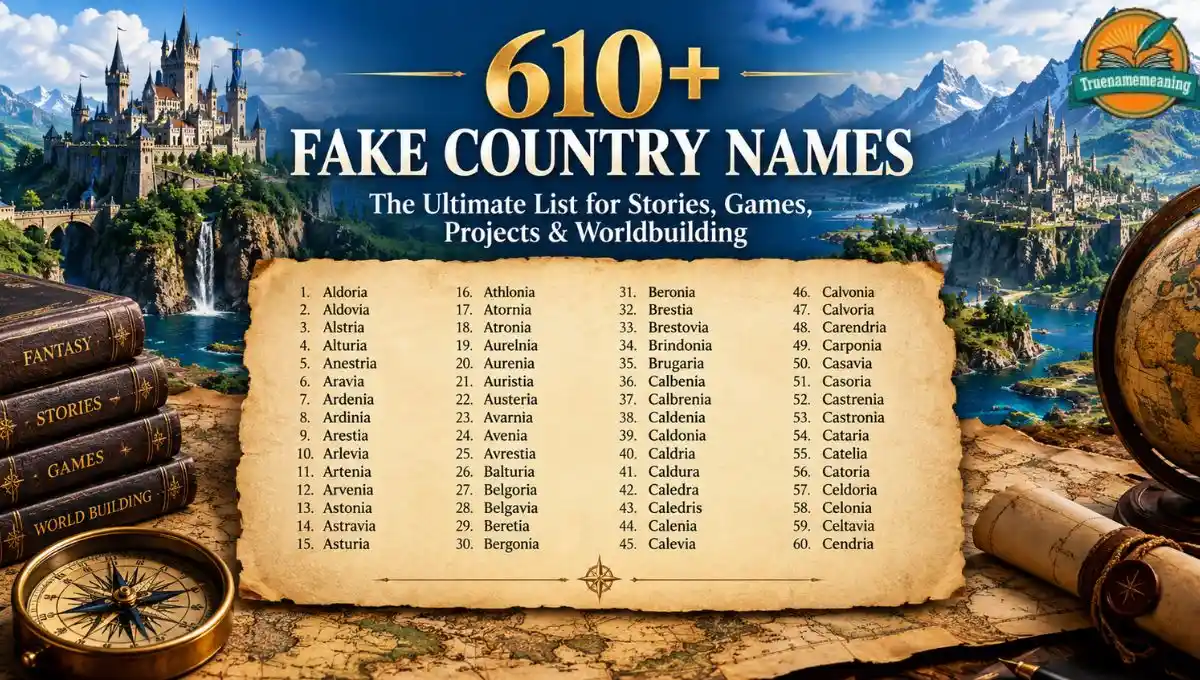
Looking for fake country names that feel believable, bold, or just plain fun? Whether you’re drafting a novel, running a tabletop campaign, or finishing a school project, the right name can do more work than you’d expect.
This guide gathers fake country names in several styles, explains the patterns that make them convincing, and shows you how to build your own from scratch.
Why Fictional Country Names Matter More Than You Think
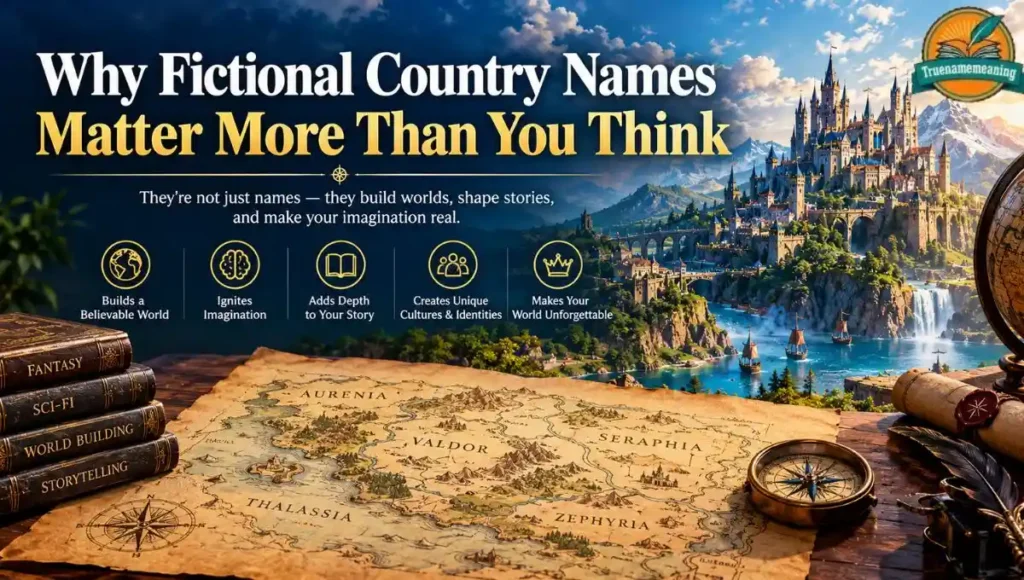
A country name is often the first detail a reader or player encounters, and it sets expectations before any description begins. “Oceania” in George Orwell’s 1984 suggests a vast superstate before the novel explains how far its reach extends. A name ending in “-mere” hints at a lake, while a name packed with hard consonants suggests a harsher place.
Names also travel. They appear on maps, in dialogue, on currency, and in the way characters describe where they come from. Players in a campaign will say the name dozens of times, and writers will type it on every page. A name that is easy to pronounce and spell earns its place.
For school projects, a thoughtful invented name shows that you planned your nation rather than grabbing the first word that came to mind. That care adds credibility to everything else you write about the country.
What Makes a Fake Country Name Sound Real?
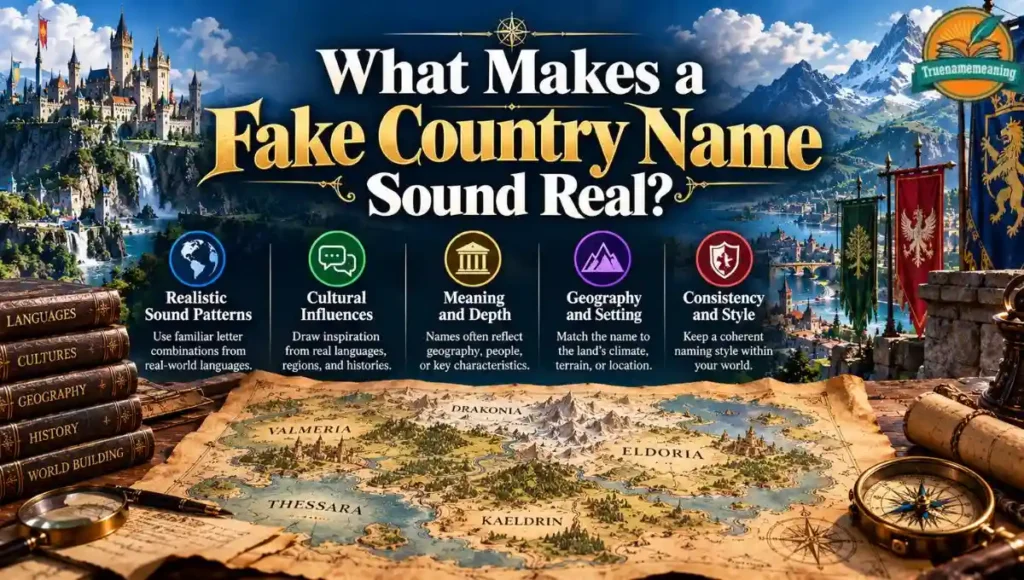
Realistic names don’t come from random letters. They follow the sound patterns, suffixes, and naming habits that real nations use, which is why some combinations feel plausible the moment you read them.
Real Country Name Patterns to Study
| Pattern | Real Examples | How to Use It |
| -ia endings | Romania, Bulgaria, Armenia | Attach the ending to an invented root, such as Varenia |
| -stan endings | Pakistan, Kazakhstan | Borrowed from Persian, where “stan” means “land”; suits a Central Asian feel |
| -land endings | Iceland, Finland | Simple and northern-sounding, such as Greymarland |
| -nia endings | Albania, Tanzania | Gives a slightly Eastern European or African flavor depending on the root |
| Short names | Chad, Mali, Laos, Peru | Punchy and easy to remember, such as Vell or Dorn |
| Geographic descriptions | Montenegro (“black mountain”), Costa Rica (often translated as “rich coast”) | Describe the land first, then build a name from that description |
| Founder names | Colombia (Columbus), Bolivia (Simón Bolívar) | Name the nation after a fictional ruler |
| Formal multiword names | Republic of Korea, Kingdom of Morocco | Adds official weight, such as Republic of Varenia |
Real nations also have demonyms, the words for their people, such as Peruvian and Japanese. A good fake country name produces a clean adjective, which makes it easier to use in writing and speech. Test this before you commit, and say the name aloud several times to check that it doesn’t tangle your tongue.
Fake Country Names That Sound Real
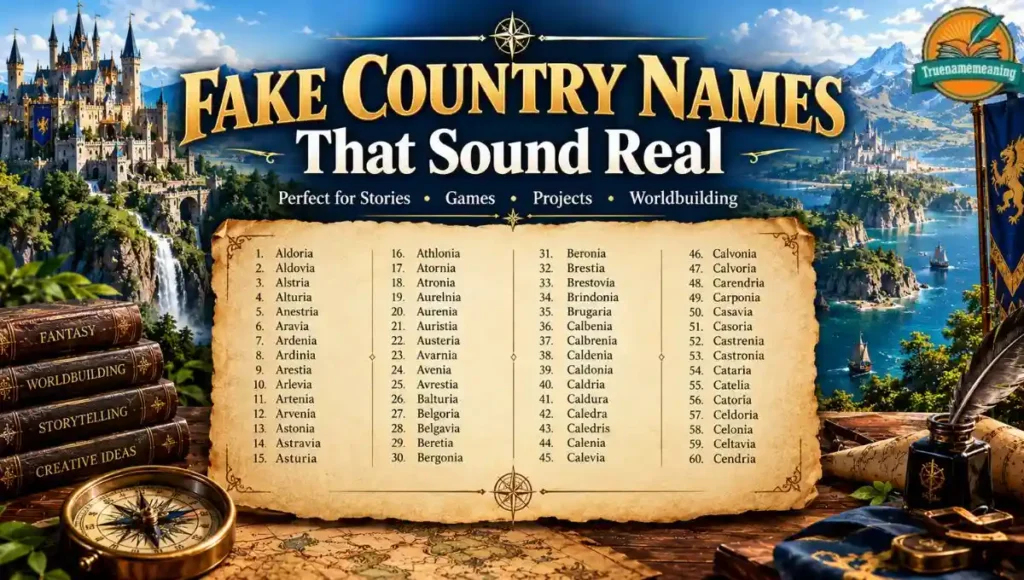
These names could show up on a real atlas without raising an eyebrow. Before you settle on one, run a quick search, since obscure towns and historical regions sometimes share names with invented ones.
European-Sounding Fake Country Names
Names built from Latin and Germanic-style suffixes feel most familiar to English readers. Aldoria
- Aldovia
- Alstria
- Alturia
- Anestria
- Aravia
- Ardenia
- Ardinia
- Arestia
- Arlevia
- Artenia
- Arvenia
- Astonia
- Astravia
- Asturia
- Athlonia
- Atornia
- Atronia
- Aurelnia
- Aurenia
- Auristia
- Austeria
- Avarnia
- Avenia
- Avrestia
- Balturia
- Belgoria
- Belgavia
- Beretia
- Bergonia
- Beronia
- Brestia
- Brestovia
- Brindonia
- Brugaria
- Calbenia
- Calbrenia
- Caldenia
- Caldonia
- Caldria
- Cald ura
- Caledra
- Caledris
- Calenia
- Calevia
- Calvonia
- Calvoria
- Carendria
- Carponia
- Casavia
- Casoria
- Castrenia
- Castronia
- Cataria
- Catelia
- Catoria
- Celdoria
- Celonia
- Celtavia
- Cendria
More European-Style Names
These names lean on softer consonants and two- or three-syllable endings, which suit Central and Northern European settings.
- Centuria
- Cervonia
- Cesthia
- Chedonia
- Chelavia
- Cheloria
- Chelovia
- Chesonia
- Chesoria
- Chetonia
- Chidronia
- Chorovia
- Cilonia
- Ciloria
- Citoria
- Cladonia
- Clavenia
- Clavoria
- Clodaria
- Clodenia
- Clodronia
- Codronia
- Colavia
- Coldenia
- Coldoria
- Colevia
- Coluria
- Color nia
- Coltenia
- Comoria
- Condria
- Consenia
- Constrenia
- Convenia
- Convoria
- Coordia
- Coravia
- Corendria
- Corenia
- Coronia
- Corpenia
- Correnia
- Cosenia
- Cosonia
- Costrenia
- Cothenia
- Cotonia
- Coudrenia
- Covenia
- Crastonia
- Cravonia
- Credonia
- Crendria
- Crestavia
- Crestonia
- Cretonia
- Crimeria
- Crindoria
- Crisania
- Cristavia
African & Middle Eastern-Sounding Fake Country Names
Names drawn from real African and Middle Eastern languages deserve extra care. Lazy “exotic” names can reinforce stereotypes, so it helps to use real roots with their actual meanings and to avoid mashing together sounds from unrelated cultures.
Useful roots include Arabic sahl (plain), jabal (mountain), raml (sand), and bahr (sea), plus Swahili nchi (land or country). That gives you names such as Sahlara, Jabalana, Ramlenti, Bahrenza, and Nchivara, the last of which is a deliberate blend that you can adjust to fit your setting.
- Abantu
- Abaria
- Abessa
- Abkura
- Aboria
- Abosia
- Absara
- Absoria
- Abtana
- Abukar
- Abundu
- Abwara
- Acanta
- Acasia
- Acavata
- Acharia
- Achuma
- Acoria
- Adania
- Adarba
- Adarra
- Adavis
- Adebia
- Adelfa
- Adessia
- Adiata
- Adibra
- Adijua
- Adikar
- Adiqua
- Adisia
- Adjara
- Adjeria
- Adjoma
- Adjuna
- Adoba
- Adoria
- Adorka
- Adraka
- Adrena
- Adriba
- Adruka
- Aduana
- Adubra
- Adukar
- Adunia
- Adusan
- Bafaria
- Bagoria
- Bahara
- Bahira
- Bakaria
- Bakassa
- Bakura
- Balara
- Baleria
- Baloria
- Balosia
- Baltara
- Baluria
- Bamara
- Bamoria
- Banaria
- Bangara
- Bangoria
- Banjara
- Banoria
- Bantara
- Bantoria
- Banuria
Asian-Sounding Fake Country Names
East and South Asian naming works best when you borrow from one language’s structure rather than several at once. Japanese kuni means “country,” and Hindi and Sanskrit desh also means “country” or “land.” That gives you Hanakuni (hana, flower), Mizukuni (mizu, water), Sorakuni (sora, sky), and Himadesh (hima, snow).
- Ankova
- Ankuria
- Aovani
- Aquaria
- Aratia
- Ardasia
- Ardoria
- Arenkai
- Arevani
- Arhalei
- Arhenia
- Ariaki
- Ariako
- Ariakon
- Ariakos
- Arialei
- Ariania
- Ariankai
- Ariankos
- Ariansei
- Ariansen
- Ariansia
- Ariaseni
- Ariasei
- Ariasenia
- Ariasenko
- Baijing
- Baladu
- Baldor
- Baleng
- Baloru
- Balung
- Baming
- Bandor
- Baneng
- Banoru
- Banting
- Banulu
- Banung
- Baoring
- Baotong
- Baqing
- Barang
- Barulong
- Baseng
- Basing
- Batong
- Batoru
- Batsung
- Baudong
- Bauong
- Baurang
- Baxeng
- Bayong
- Bayoru
- Chengado
- Chilong
- Cholang
- Choneng
- Chorong
- Choseng
- Chotang
Latin American-Sounding Fake Country Names
Spanish geographic words such as costa (coast), tierra (land), valle (valley), laguna (lagoon), and monte (mountain) give names a natural, everyday feel.
Costaverde (green coast), Tierraluna (land of the moon), Vallealto (high valley), Lagunazul (blue lagoon), and Montelindo (beautiful mountain) all describe a landscape in plain Spanish, which makes them easy to picture.
- Abasona
- Abavera
- Abdura
- Abecosta
- Abeflora
- Abegona
- Abejos
- Abejoso
- Abelora
- Abemar
- Abemara
- Abenova
- Abeora
- Abequera
- Abequero
- Aberana
- Aberano
- Aberio
- Aberion
- Aberioso
- Aberis
- Aberjosa
- Aberjoso
- Aberma
- Abermosa
- Abermoso
- Cabavera
- Cabecosta
- Cabeflora
- Cabegona
- Cabejos
- Cabemar
- Cabenova
- Cabeora
- Cabrales
- Cabranca
- Cabrano
- Cabreira
- Cabreiro
- Cabrena
- Cabreno
- Cabrenza
- Cabreria
- Cabrerio
- Cabrerios
- Cabreron
- Cabrerona
- Cabreros
- Delveras
- Delverco
- Delverde
- Delvero
- Delveros
- Delverta
- Delverto
- Elcosta
- Elfuego
- Elgrado
Fictional Country Names That Sound Real
This group borrows real word roots instead of full names. Readers recognize the Latin, Czech, or German word hiding inside, which gives the country a sense of history without copying any real nation.
| Name | Borrowed Root | Root Meaning |
| Vernalia | Latin vernus | Spring |
| Lumenara | Latin lumen | Light |
| Aquabel | Latin aqua | Water |
| Tenebria | Latin tenebrae | Darkness |
| Zelenova | Czech zelený | Green |
| Vysokaria | Czech vysoký | High |
| Waldmark | German Wald + Mark | Forest + border territory |
| Montarra | Italian monte | Mountain |
A root works best when you pair it with a suffix that matches your setting. Vysokaria suits a mountain nation, while Lumenara fits a sunlit coastal kingdom.
Read More: 560+ Duck Names: Funny, Cute & Creative Ideas for Every Pet Duck
Cool Made-Up Country Names
Cool fake country names sound confident and a little unfamiliar. They often combine hard consonants with open vowels, which gives them weight when spoken aloud.
| Name | Why It Works |
| Vorthalis | Heavy “v” and “th” sounds give it a commanding presence |
| Kaelmar | A sharp “k” opening with a soft finish is easy to say |
| Zorvane | The strong “-ane” ending feels like a real nation |
| Veyrax | Short, sharp, and easy to remember |
| Obsidara | Evokes volcanic glass, with a regal “-ara” ending |
| Nythrax | Hard consonants give it an edgy, militant feel |
| Thessaryn | Elegant and musical, with a graceful rhythm |
| Ashkvar | Gritty “sh” and “k” sounds suggest a rough land |
| Brakvane | Blunt and industrial, suited to a hard-working state |
Fantasy Country Names
Fantasy names can break from real geography and lean into magic, weather, and myth. The best ones still suggest something about the land, so readers can picture it before the story begins.
| Name | What the Place Feels Like |
| Mirewake | A marsh kingdom where the bogs seem to stir at night |
| Glassreach | A desert nation whose sands have fused into glass |
| Thornvale | A valley ringed by thorn hedges and hostile plant life |
| Gloamhold | A fortress realm lit only by twilight |
| Ashmere | A lake country whose shores are dusted with volcanic ash |
| Sunderhollow | A cave kingdom split from the surface by a vast chasm |
| Wyrmfell | A mountain land where dragons are said to nest |
| Verdantis | A lush empire of endless forests and old roads |
| Lumenmoor | A misty upland where light bends strangely |
| Vaelmarch | A border kingdom permanently facing whatever lies beyond it |
| Frostspire | An icebound nation built around a single frozen peak |
Unique & Creative Fake Country Names
Sometimes you want a name that sounds like no real place at all. The trick is consistency. Pick a small set of sounds and reuse them across your world, so every name feels like part of one language. For example, a world built around el-, ith-, and -ren can produce Eluvara, Ithrenne, and Elithren without any of them clashing.
Other examples built this way include Sorimel, Quenvar, Yzolde, Tavrinn, Oruveth, Maelisk, Xeravin, and Ulventhar. Try saying each one in a sentence such as “the people of never forgot the flood” to see whether it fits the tone you want.
- Aelvara
- Aelvaris
- Aelven
- Aelvenia
- Aelvenar
- Aelvenas
- Aelvenat
- Aelvenel
- Aelvener
- Aelveney
- Aelvenhar
- Aelvenhara
- Aelvenholm
- Aelveniar
- Aelvenil
- Aelvenilar
- Aelvenilis
- Aelvenilon
- Aelvenilos
- Aelveniloth
- Aelvenilox
- Aelveniloy
- Aelvenilun
- Aelvenilyn
- Aelvenimar
- Aelvenimas
- Aelvenin
- Aelveninar
- Aelveninas
- Aelveninat
- Aelvenion
- Aelvenioran
- Aelveniorar
- Aelvenorath
- Azurith
- Azurithia
- Azurithal
- Azurithian
- Azurithiar
- Azurithias
- Azurithiat
- Azurithion
- Azurithor
- Azurithora
- Azurithorar
- Azurithorath
- Azurithoras
- Celindra
- Celindras
- Celindrath
- Celindray
- Celindrel
Sci-Fi & Futuristic Nation Names
Science fiction nations often reflect technology, governance, or the aftermath of a crisis. Their names usually signal how the nation came to be or what it values.
| Name | What It Suggests |
| Kepler Concord | A treaty-based state formed around a distant planetary colony |
| Halcyon Directorate | A centrally managed nation where efficiency is law |
| Vanguard Assembly | A founding-era government that still claims its mandate |
| Lattice Commonwealth | A federation of linked space habitats |
| Ceres Free State | A mining republic on the dwarf planet Ceres |
| Tethys Accord | A moon-based nation governed by a shared treaty |
| Nullspace Union | A digital nation whose borders exist only on networks |
| Corvus Hegemony | A dominant power built on conquest |
| Haven Drift | A generation-ship nation that has never reached its destination |
| Meridian Reach | A prosperous nation at the edge of known space |
Fake Country Names for Maps, Flags & Worldbuilding
A name is only the start. Once you commit to a fictional country, you’ll need a capital, a language, a currency, and a flag, and keeping them consistent makes the whole nation feel solid.
Before you fall in love with a name, check for collisions. Search it in GeoNames, a searchable database of place names, and run a general web search for the name paired with “town” or “country.” If you plan to sell a product that uses the name, also check the USPTO’s trademark search.
Once the name passes, build the surrounding details around it:
- Capital: Name it after a river, a founder, or a landmark, so it connects to the rest of the nation.
- Demonym: Derive the adjective directly from the country name so it reads naturally.
- Currency: Choose a unit that echoes the country’s sound palette.
- Language: Reuse the same syllables and roots as the country name.
- Flag: Base the symbol on the land or history, and use no more than two or three colors so it stays readable at small sizes.
As a worked example, Varenia might have Varenian citizens, a capital called Oseth, a currency called the varen, and a flag with a silver river running across a green field.
Here are 30 ideas for maps, national flags, and worldbuilding projects:
- Amber Coast
- Ashen Republic
- Bluehaven
- Brighthold
- Cloudmere
- Copper Coast
- Crownreach
- Eastvale
- Everharbor
- Fairhaven
- Farwind
- Golden Vale
- Greenmarch
- Highcrest
- Kingsmere
- Lakehaven
- Longshore
- Northvale
- Oakenshore
- Redwater
- Rosemark
- Seabright
- Silver Coast
- Southwatch
- Sunvale
- Three Rivers
- Westhaven
- Windmere
- Winter Coast
- Willowreach
Fictional Country Names Based on Geography, Climate & Landscapes
Geography gives a fictional country its shape. A name that matches the land helps readers picture the terrain before you describe it.
| Landscape | Name Pattern | Examples |
| Mountains | -peak, -spire, -crest | Stonecrest, Caelspire |
| Rivers and deltas | -ford, -mouth, -delta | Silverford, Mirrowmouth |
| Marshes and lakes | -fen, -mere | Brackfen, Owlmere |
| Deserts | -waste, -dune | Ochrewaste, Emberdune |
| Islands | -isle, -ey, -holm | Tarnisle, Halvey |
| Coasts | -shore, -reach | Brinereach, Saltshore |
| Forests | -weald, -wood | Thornweald, Ashweald |
| Frozen north | -rime, -hold | Rimehold, Icewold |
| Volcanic land | -cinder, -deep | Cinderdeep, Pyreholm |
Many of these endings come from Old English and Old Norse, the languages behind real place names such as the Orkney Islands, whose “-ey” ending means island. Using them gives your fictional geography the same historical texture.
Fake Country Names for RPGs, Dungeons & Dragons, and Video Games
Tabletop and video game worlds depend on memorable nations, since players will travel through them, fight over them, and argue about them. Published settings show how a name can carry an entire culture.
The Forgotten Realms, a Dungeons & Dragons setting, includes nations such as Cormyr, Sembia, Thay, and Amn, each with its own sound and identity. Eberron, another official D&D setting, uses names such as Breland, Aundair, Thrane, and Karrnath. In video games, The Legend of Zelda’s Hyrule and The Elder Scrolls’ Tamriel show how a single name can stand for a whole world.
When you name nations for your own campaign or game, a few practical habits help:
- Match the name to the terrain or culture, so it hints at what players will find there.
- Keep names easy to say aloud at the table, and avoid pairs that sound alike, since players will mix them up.
- Record each nation’s name, demonym, capital, and a one-line description in a shared campaign document.
ere are 30 RPG country names for fantasy campaigns and video games:
- Dragonspire
- Eldergate
- Veyrath
- Mooncrest
- Ravenspire
- Stormhaven
- Valemarch
- Duskoria
- Thaldrin
- Emberhold
- Grimvale
- Dawnforge
- Wyvernreach
- Starfall
- Thornspire
- Runebarrow
- Mythrendale
- Ashen Crown
- Frostwarden
- Blackthorn Realm
- Silverfang
- Kingshade
- Wyrmholt
- Hollowspire
- Sunforged
- Mistwarden
- Ironveil
- Eldoria
- Nightspire
- Oathmere
Steampunk-Themed Fictional Nation Names
Steampunk nations blend Victorian-era place names with industrial vocabulary, so the result sounds like an empire of rail lines, brass fittings, and coal smoke.
English place names often end in -ton, -ford, -wick, -holm, or -burgh. Pair those endings with words such as iron, brass, coal, steam, and gear, and you get an instant period feel.
Here are 35 steampunk country names:
- Aethermoor
- Aethernia
- Aetherton
- Aldgate
- Aldwick
- Alford
- Algate
- Algrave
- Algwick
- Alhart
- Alhaven
- Alheim
- Alhill
- Alholt
- Alhorn
- Alkirk
- Alkwick
- Almark
- Almill
- Almore
- Amberton
- Amberwick
- Amberworth
- Amberwyn
- Arken
- Arkgate
- Arkholm
- Arkmore
- Arkport
- Arkshire
- Arkthorn
- Arkwick
- Ironford
- Irongate
- Ironholm
Dark & Sinister Fictional Country Names
Every good fictional world needs a nation that unsettles readers. Dark names work best when they suggest a history rather than simply sounding ominous.
| Name | What the Name Implies |
| Sablegrave | A nation built over an old burial ground |
| Wraithmarch | A border territory where the dead are said to walk |
| Ruinhollow | The remains of an empire that never recovered |
| Gallowmere | A lake country with a grim history of executions |
| Scarnheath | A barren heath scorched by a war nobody remembers |
| Tenebrae | Latin for “shadows,” a nation that has known only dusk |
| Hollowrot | A land whose wealth decayed along with its founders |
| Ashgarrow | A fortress state on a plain of volcanic ash |
Keep villainous nations focused on places and histories rather than on real ethnic groups or religions. A fictional regime that echoes historical cruelty is more compelling when readers see its consequences than when they see a caricature.
Read More: 510+ Ninja Names: The Ultimate Guide to Shinobi Names for Every Purpose
Funny Fake Country Names
Sometimes a country name should get a laugh. Comedy names work best when the joke is visible in the name itself and a single detail explains it.
| Name | The Joke |
| Almostia | Always about to become a country, and still negotiating its independence |
| Sockland | Every missing sock eventually turns up here |
| Snoozeland | The national pastime is a nap, taken every afternoon |
| Brunchovia | Its only holiday is a weekend brunch that closes at 2 p.m. |
| Waitlistan | Citizenship applications have been processing since 1987 |
| Forgetania | Nobody remembers the capital, or whether it exists |
| Traffikstan | Every road is under construction, indefinitely |
| Mondaya | Every week begins here, and nobody has ever finished one |
Keep the humor gentle. Jokes that punch down at real cultures age poorly and can derail a project.
Fake Country Names for School Projects
School projects need names that look credible on a poster and sound natural in a presentation. Aim for a name that is clearly invented, easy to spell, and simple to say aloud.
Avoid three common mistakes. Silly names can make a teacher question the whole assignment. Names that are close to a real country can cause confusion. Awkward names with tricky sounds become a burden when you have to repeat them dozens of times.
Best Fake Country Names for School Projects
| Name | Why It Works for a Project |
| Varenia | Three syllables, clearly European in feel, and easy to spell |
| Caldrin | Short and sturdy, and it works in headlines |
| Lenmora | Soft and memorable, with a natural adjective, Lenmoran |
| Ostrenia | Easy to say and sounds like a real Eastern European state |
| Belsara | Musical and works well in formal writing |
| Thorvane | Sounds official without being silly |
| Merostia | Flows naturally in spoken presentations |
| Ardelia | Gentle and distinctive, with a pleasant four-beat rhythm |
A simple formula helps. Choose your name, add an official-sounding phrase such as “Republic of,” “Kingdom of,” “Federation of,” or “Commonwealth of,” and build the adjective with -ian, -an, or -ese. “The Republic of Varenia” gives you Varenian citizens and a Varenian capital, and both read naturally in a sentence.
Famous Fictional Countries in Pop Culture
Famous fictional countries show how writers and filmmakers use names to set tone and history. Studying them is one of the fastest ways to learn what works.
Famous Fictional Countries in Literature & Film
| Country | Source | Why the Name Works |
| Ruritania | The Prisoner of Zenda (1894), Anthony Hope | An early template for the invented European kingdom; it sounds Eastern European without matching a real state |
| Syldavia | Hergé’s Tintin comics | An East European flavor, with an ending readers associate with that region |
| Borduria | Hergé’s Tintin comics | A harsher sound that suits its role as the antagonist nation |
| Graustark | George Barr McCutcheon’s 1901 novel | A Germanic-sounding name with a storybook charm |
| Narnia | C.S. Lewis’s The Chronicles of Narnia | Often linked to Narni, an Italian town with a Latin name; the “-ia” ending feels ancient |
| Gondor | J.R.R. Tolkien’s The Lord of the Rings | A Sindarin name often glossed as “stone-land,” which suits its fortified cities |
| Panem | Suzanne Collins’s The Hunger Games | Drawn from the Latin phrase panem et circenses, “bread and circuses” |
| Gilead | Margaret Atwood’s The Handmaid’s Tale | A Biblical place name that signals a religious, authoritarian state |
| Oceania | George Orwell’s 1984 | The name conveys scale, describing a superstate that spans much of the world |
| Wakanda | Marvel Comics | First appeared in Fantastic Four in 1966; suggests an African nation without copying a real one |
| Latveria | Marvel Comics | An Eastern European-style nation ruled by Doctor Doom, with a gothic tone that the name reinforces |
Famous Fictional Countries in TV
Television and film both rely on invented nations for convenience, so a few of these names come from movies. They follow the same naming logic as the book examples above.
| Country | Source | Why It Works |
| Kamistan | 24 | A fictional nation that drives major plotlines in the series |
| Florin & Guilder | The Princess Bride | Deliberately generic European kingdoms, played for satire |
| Genovia | The Princess Diaries | A small European principality with a Mediterranean feel |
| San Marcos | Bananas (1971) | A fictional Latin American nation used for political satire |
| Val Verde | Commando (1985) and Die Hard 2 (1990) | A go-to fictional Central American nation in action films |
| Sokovia | Avengers: Age of Ultron (2015) | A name with a Slavic sound and a “-via” ending |
Alternate History Country Names
Alternate history asks what might have happened if one turning point had gone differently. Names in this genre carry a built-in question, so readers immediately want to know what changed.
| Name | The Divergence It Suggests |
| Ottoman Iberia | Ottoman power takes hold of the Iberian Peninsula |
| Tenochtitlan Republic | The Aztec capital survives European conquest and becomes a republic |
| Hanseatic Baltic Union | The Hanseatic League keeps its trading dominance into the modern era |
| Hawaiian Pacific Empire | The Hawaiian monarchy survives its 1893 overthrow and grows into a Pacific power |
| Tawantinsuyu Federation | The Inca Empire, known by its Quechua name, survives and adapts |
| Byzantine Iberia | The Byzantine Empire holds territory on the Iberian coast |
Be careful with alternate histories that involve colonization or conquest. Showing the human cost honestly, rather than treating colonial power as an exciting premise, makes the story stronger and more credible.
Read More: 110+ Double Barrel Names: Beautiful Ideas for Girls, Boys and Unisex Babies
Mythology-Inspired Fake Country Names
Myth gives names built-in history and symbolism. Most of the names below come from real traditions, and the Norse example is a compound built from two real elements.
| Name | Source | Meaning or Notes |
| Ymirheim | Norse (compound) | Built from Ymir, the primordial giant of Norse myth, and -heim, “home” |
| Hyperborea | Greek | A legendary land “beyond the North Wind” |
| Ialu | Egyptian | The “Field of Reeds,” an idealized afterlife landscape |
| Annwn | Welsh | The Otherworld in Welsh tradition; spelling varies (Annwfn) |
| Tír na nÓg | Irish | “Land of Youth,” a paradise in Irish myth |
| Takamagahara | Japanese (Shinto) | “Plain of High Heaven,” the realm of the kami |
| Xibalba | K’iche’ Maya | The underworld, often glossed as “place of fear” |
| Svarga | Sanskrit | Heaven or the celestial realm in Hindu and Buddhist texts |
Several of these names are sacred to living traditions. In fiction, describe the nation without mocking its beliefs, and consider whether an invented variation would be more respectful.
How to Create Your Own Fake Country Name
The lists above cover a lot of ground, but you may need something specific. These methods use the same tools that produce convincing names in the real world.
- Start with a suffix. Take an invented root and add an ending such as -ia, -land, -stan, or -via. “Keld” plus “-ia” gives you Keldia, and “Storm” plus “-ia” gives you Stormia.
- Borrow a root. Pick a word from a real language that fits your setting. The Welsh mynydd means mountain, so a mountain nation could become Mynydria. Keep the borrowed word recognizable, and check its meaning before you use it.
- Name it after a founder. Create the ruler first, such as Aldric the Great, and derive the country from the name, giving you Aldrica. This adds built-in history to the name.
- Blend invented syllables. Combine sounds from your own made-up roots rather than from two real country names. Blending real names too closely can create an accidental joke or an unintended real-world reference.
- Describe the land. Write a plain-language description of the geography, then turn one key word into a name. “Mountain” becomes Montoria, from the Latin mons.
To test any finished name, write “the Republic of” in front of it and say it aloud several times. Check the adjective form, search the name in a gazetteer, and confirm it doesn’t match a real place before you use it widely.
FAQ’s
What are some good fake country names for a school project?
Strong options include Varenia, Caldrin, Lenmora, and Belsara, because they are easy to spell, clearly invented, and work with phrases like “Republic of.” Choose a name with a simple adjective form so your citizens and capital read naturally.
How do I make a fake country name sound realistic?
Use the suffix and root patterns real nations use, such as -ia, -stan, or -land, and pair them with a root that suggests the landscape. Then test the name in a sentence like “the Kingdom of Ardelia” to see whether it sounds natural.
What makes a good name for a fantasy kingdom?
A good fantasy kingdom name hints at the land, such as Thornvale for a valley of thorns or Frostspire for an icy mountain nation. Pick a demonym and capital that match the culture you imagine.
What are some famous fictional countries from books and movies?
Ruritania, Syldavia, Gondor, Panem, and Oceania are among the most recognized fictional countries from novels and films. Each name hints at the nation’s character before the story describes it.
Which D&D settings have well-known fictional nations?
The Forgotten Realms and Eberron are two official Dungeons & Dragons settings with well-known nations, including Cormyr in the Realms and Breland in Eberron. Their names show how a setting can give each nation a distinct sound and identity.
How do I create my own fake country name?
Start with a suffix, a borrowed root, or a founder’s name, then test the result by saying it in a sentence with “Republic of” or “Kingdom of” in front. Keep the name consistent with the capital, language, and demonym you choose.
How can I check whether a fake country name is already a real place?
Search the name in GeoNames, a database of place names, and run a general web search with “town” or “country” added. If you plan to sell a product using the name, also check the USPTO’s trademark search.
Conclusion
Good fake country names do more than fill a blank space on a map. They suggest history, geography, and tone before a reader or player sees a single scene. The strongest names are easy to say, consistent with the rest of the world, and distinct enough to remember.
Start with the lists above, then test your favorites by building out a capital, a demonym, and a flag. When the name holds up in a sentence and across all of those details, it’s ready to use.

I’m M Umair, the author behind True Name Meaning. I have experience researching names, their origins, meanings, history, and biblical significance. I focus on reliable information and simple explanations to help readers discover the true meaning and story behind every name.