Choosing the right planet name ideas can bring your fictional universe to life. Whether you’re building a sci-fi story, fantasy world, video game, or D&D campaign, a memorable planet name helps establish its identity, atmosphere, and history.
This collection of 820+ Planet Name Ideas features cool, unique, alien, fantasy, funny, cute, and mysterious names for every type of imaginary world. You’ll also discover planet names inspired by mythology, colors, natural elements, oceans, deserts, ice, and distant galaxies.
Whether you need a name for a fictional planet, an extraterrestrial civilization, or an entire planetary system, this guide will help you find the perfect inspiration. You’ll also learn how to create original planet names using meaningful roots, creative suffixes, and practical worldbuilding techniques.
How Real Planets Get Their Names: IAU Rules & Astronomical History

Real planetary names come from centuries of astronomy, mythology, cultural traditions, and scientific discovery. Learning how astronomers name planets can help you develop a believable naming system for your own fictional universe.
The International Astronomical Union (IAU), established in 1919, is the international organization responsible for many official astronomical naming conventions. It coordinates the naming of celestial bodies and features, including exoplanets.
Its conventions provide useful inspiration for fictional planet naming, although invented worlds don’t need to follow every scientific rule.
For example, the eight planets in our solar system have established names rooted mainly in Greco-Roman mythology, with Earth and Uranus providing notable exceptions to the dominant Roman tradition. Many exoplanets, meanwhile, have technical designations based on their host stars and discovery history.
A fictional universe can use several naming approaches:
- Mythological names: Suitable for ancient, sacred, or powerful worlds.
- Scientific designations: Ideal for realistic space exploration stories.
- Cultural names: Useful when different alien civilizations have their own languages.
- Descriptive names: Effective for worlds known for distinctive environments or features.
- Invented names: Best when you want an original identity for an imaginary planet.
How Our Solar System’s Planets Got Their Names
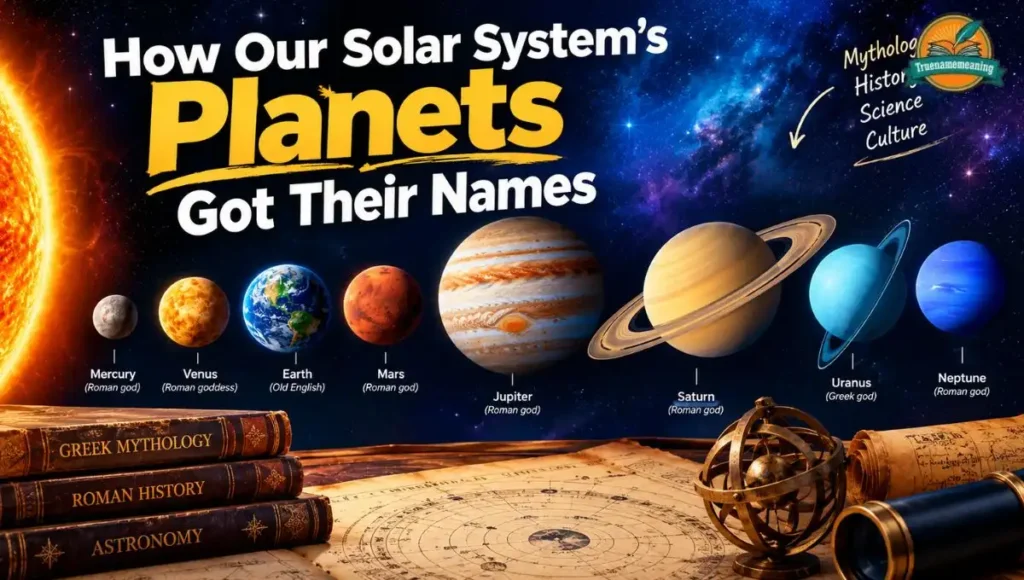
The planets in our solar system demonstrate how a name can reflect mythology, historical tradition, or a celestial body’s appearance.
| Planet | Name origin or association |
| Mercury | Roman messenger god, associated with speed |
| Venus | Roman goddess of love and beauty |
| Earth | Derived from Old English and Germanic words associated with ground or land |
| Mars | Roman god of war, associated with the planet’s reddish appearance |
| Jupiter | King of the Roman gods, fitting the largest planet |
| Saturn | Roman god associated with agriculture and time |
| Uranus | Named after the Greek personification of the sky |
| Neptune | Roman god of the sea, associated with the planet’s blue appearance |
These examples show why mythology-inspired planet names remain effective for worldbuilding. A name such as Aurelia suggests gold and brightness, while Thalassa evokes the sea. Such associations can help readers understand a world before they learn its full history.
The Phonosemantics of Planet Name Ideas: Why Certain Names Feel Alien
Phonosemantics explores how sounds can create impressions of meaning, even when a word is invented. For planet name ideas, sound is a creative tool: hard consonants may suggest danger, while flowing vowels can make a world seem peaceful or beautiful.
These associations aren’t universal rules. Language, culture, and personal experience affect how people interpret sounds, but consistent sound patterns can help establish a recognizable identity for your fictional planets.
| Planet type | Useful sound patterns | Example names |
| Harsh desert world | K, R, X, T | Kharvex, Drakos, Vexara |
| Peaceful paradise | A, E, L, soft vowels | Elaria, Serenova, Avelune |
| Frozen planet | K, T, I, crisp endings | Kryth, Kelvoria, Iceron |
| Ocean planet | M, L, S, flowing sounds | Thalassa, Marivelle, Solmara |
| Ancient mysterious world | Longer names and unusual rhythms | Xandorath, Veltharion, Nyxavelle |
| Massive gas giant | Deep vowels and rolling syllables | Colossara, Jovareth, Vastrion |
Try saying a name aloud before choosing it. “The expedition has reached Kharvex” creates a different impression from “The expedition has reached Elaria.” That difference can reinforce your story’s mood without requiring a lengthy explanation.
Planet Name Ideas Generator Formula
A Planet Name Ideas generator can help you brainstorm, but you can also create better results manually by combining a world’s defining features with a consistent naming style. This four-step method works for science fiction, fantasy, tabletop RPGs, and original fictional universes.
Step 1: Determine the Planet’s Defining Trait
Begin with the feature that matters most to your story. Is the planet a frozen wasteland, an ancient civilization’s birthplace, a peaceful colony, or a dangerous world near a dying star?
Write down three traits before naming it. For example, a volcanic planet might be hot, mineral-rich, and politically unstable. Those traits could inspire names such as Ignivara, Cindrath, and Vulkaris.
Step 2: Choose a Root
A root is the meaningful sound, word, or idea at the center of your planet name. Consider these approaches:
- Nature: Sol (sun-associated), Aqua (water-associated), Glac (ice-associated).
- Mythology: Gaia (Greek Earth figure), Nyx (Greek night goddess), Thor (Norse thunder god).
- Astronomy: Nova, Astra, Zenith, Eclipse.
- Invented language: Veyr, Khar, Zor, Elun.
- Cultural history: Draw inspiration from a language or tradition you have researched, rather than combining unfamiliar cultural terms randomly.
For example, combining a fire-associated root with a soft ending could produce Ignara, while a root associated with darkness might inspire Nyxovar.
Step 3: Add a Planetary Suffix
Suffixes can help make names sound related without making every planet identical. These endings are creative conventions, not official astronomical rules.
| Suffix or ending | Suggested style | Example |
| -ia | Elegant or classical | Veloria |
| -on | Futuristic or powerful | Krython |
| -is | Alien or mysterious | Vexaris |
| -ara | Magical or lyrical | Solara |
| -os | Ancient or commanding | Thaloros |
| – Prime | Main colony or important world | Aster Prime |
| – IV | Numbered planet in a system | Kelvar IV |
Use suffixes consistently when planets share a language or civilization. Different endings can distinguish cultures, historical periods, or planetary roles.
Step 4: Test Pronunciation and Distinctiveness
A planet name idea should be easy enough to recognize when readers encounter it repeatedly. Say it aloud in a sentence, check whether it resembles an existing fictional world too closely, and consider how it looks on a map.
Try these examples:
- “The fleet will arrive at Veyrion before dawn.”
- “No ship has returned from the surface of Kharvex.”
- “The royal archives were moved to Elaria Prime.”
If the name is difficult to pronounce, consider simplifying its consonants. If every planet in your universe sounds similar, change the roots or suffixes to create more variety.
Best Planet Name Ideas
The best planet names are memorable, flexible, and appropriate for their setting. These planet name ideas work as starting points for novels, games, imaginary worlds, and original planetary systems.
Best Planet Names with Meanings
The following options combine recognizable linguistic associations with clearly invented names. Invented meanings are creative interpretations rather than established dictionary definitions.
| Planet name | Meaning or inspiration |
| Aurelia | Latin-associated root meaning golden |
| Elysara | Inspired by Elysium, a paradise in Greek mythology |
| Meridian | A geographic and astronomical term suggesting a central line |
| Astralis | Inspired by Latin astrum, meaning star |
| Ignara | Invented name with a fire-associated root |
| Nyxara | Inspired by Nyx, the Greek goddess of night |
| Thaloria | Inspired by Greek thalassa, meaning sea |
| Solvane | Invented name suggesting sunlight |
| Cryovant | Inspired by the scientific prefix cryo-, associated with cold |
| Zephyria | Inspired by Zephyrus, the Greek god of the west wind |
| Obsidara | Inspired by obsidian, a volcanic glass |
| Verdalis | Inspired by verde, associated with green |
| Luneth | Inspired by lunar imagery |
| Celestara | Inspired by celestial imagery |
| Novarion | Inspired by the astronomical term nova |
| Halcyra | Inspired by the idea of calm and tranquility |
| Vespera | Inspired by the Latin word associated with evening |
| Pyrelis | Invented name suggesting firelight |
| Umbriel | A name also used by a real moon of Uranus |
| Seravelle | Invented name suggesting elegance and serenity |
More Best Planet Names Quick Reference
For quick inspiration, explore these additional cool Planet Name Ideas. They can suit a homeworld, distant colony, imperial capital, or unexplored frontier.
- Powerful: Dravorn, Kestrax, Valturion, Zorvex, Korvath, Threxon, Draxion, Vornak, Tyravex, Kaldros.
- Elegant: Elowara, Lumeria, Avenelle, Isolara, Veloria, Serenith, Calystria, Orlena, Ambrielle, Solenne.
- Mysterious: Veylora, Noxaris, Xandrel, Morvane, Ithryx, Vaelthorn, Orynth, Quoralis, Nythera, Zenthara.
- Futuristic: Nexaris, Novatek, Axionis, Vortexa, Keltrion, Zynthera, Cyvaris, Quantara, Xeltron, Orbinex.
Fictional & Made-Up Planet Names
Made-up planet names are most convincing when they suggest a history, language, or naming convention. Use the following options for fictional worlds, space colonies, distant empires, and unexplored planets.
- Avarenth
- Kelvara Prime
- Threxos IV
- Vantageth
- Cindrax Minor
- New Meridian
- Aldevar
- Brontara
- Corvantis
- Dravengale
- Estrellan
- Fendriska
- Glorindar
- Havenora
- Isendral
- Jovannis
- Kestraline
- Lyrathane
- Mordekai IX
- Nyxendor
- Orithane
- Pelluvia
- Quorvath
- Ravensong
- Sylvestris
- Thornheim
- Ulvantar
- Vestara
- Whisperveil
- Xandrium
For additional variety, try names such as Ossavelle, Meridrax, Veyloria, Arctyron, Duskara, Valtheris, Orynvale, Solthara, and Evendros. Add a designation such as Prime, Minor, or a Roman numeral when the planet belongs to a larger system.
Alien Planet Name Ideas
Alien planet names should feel as if they come from a language with its own sounds and rules. Unusual syllables can create an extraterrestrial impression, but consistency matters more than adding random apostrophes or Xs.
- Xar’thul
- Q’renna
- Vex’targon
- Zzyzara
- K’thress
- Yvon’tal
- Zorathix
- Nyx’quel
- Threx’ion
- Vulk’ara
- Zenithra
- Q’baltir
- Krynn’dor
- Xhalvest
- Zorvexis
- Ythrandor
- Quel’mira
- Vranthex
- Zylophar
- Krethnos
- Ixthal
- Novakrell
- Praxithor
- Skarvenix
- Vexulon
- Qorvessa
- Xyrathen
- Thal’kora
- Zenthrix
- Oquellion
For an alien civilization with a softer, more musical language, consider Ael’qira, Ilythene, Oruvessa, Xaelori, and Yunthara. For a technologically advanced species, Krynthex, Vortaq, Zexulon, and Qorvaxis may better match the tone.
Fantasy Planet Names
Fantasy planet names often evoke ancient magic, enchanted forests, celestial kingdoms, and forgotten civilizations. These fantasy planet names can also serve as names for magical worlds, fictional realms, and fantasy universes.
- Aelindor
- Sylvaneth
- Mysthaven
- Thornrealm
- Celestyn
- Faewild Prime
- Glimmerath
- Ironspire
- Lumendor
- Moonrealm
- Nightveil
- Oakenworld
- Prismara
- Runethane
- Starweave
- Twilightor
- Umbraleth
- Verdanor
- Windmere
- Ashenworld
- Brightspire
- Crystalreach
- Dawnrealm
- Emberworld
- Eldervale
- Moonspire
- Spelloria
- Mythralune
- Everdawn
- Faerindel
Other magical world names include Aetherwyn, Eldoria, Wyrmfall, Silvermere, Runewillow, Starhaven, Dragonveil, Moonwhisper, Everthorn, and Glimmerwyn. Pair these names with a legend or magical feature to make the world feel more complete.
Cool Planet Names
Cool planet names are often short, confident, and easy to remember. They work particularly well in action-heavy science fiction, space exploration games, and stories involving rival empires.
- Kryonis
- Voss
- Draxis
- Nyra
- Ferox
- Zenar
- Kaldeth
- Vortan
- Ryzal
- Skorn
- Tessarine
- Vandark
- Wraithe
- Xantar
- Yveron
- Zorak
- Blackpoint
- Coreward
- Duskarion
- Emberfall
- Frostgate
- Gravenholm
- Ironvale
- Jetstream
- Kharadon
- Nightforge
- Stormrax
- Vexholm
- Warhaven
- Zenthros
For a military science fiction setting, Blackpoint, Stormrax, and Warhaven suggest strategic importance. For a mysterious frontier, Voss, Kryonis, and Coreward offer shorter, more understated options.
Unique & Creative Planet Names
Unique planet names can draw inspiration from less familiar linguistic roots, unusual natural features, or original combinations. When borrowing from real cultures, research the actual meaning and pronunciation instead of assigning an invented meaning to an authentic name.
| Planet name | Inspiration or context |
| Sarasvana | Invented name inspired by the sound of Sarasvati |
| Anansaris | Inspired by Anansi, a figure in Akan and related West African traditions |
| Tlalocan | A name rooted in Aztec mythology |
| Ratatoskrun | Inspired by Ratatoskr from Norse mythology |
| Marduvane | Inspired by Marduk, a Babylonian deity |
| Osirian | Inspired by Osiris, an Egyptian deity |
| Quintessa | Elegant, classical-sounding name |
| Halcyara | Invented name suggesting peace |
| Verendel | Invented name with a pastoral tone |
| Osmovane | Invented name suggesting an ancient world |
| Kethrandi | Invented alien-style name |
| Prospera | Associated with prosperity |
| Ambrivell | Invented name suggesting an amber-colored landscape |
| Duskarath | Invented name suggesting twilight |
| Elyndrith | Invented fantasy name |
| Faronel | Invented lyrical name |
| Grovendal | Inspired by groves and valleys |
| Isharyn | Invented name with a mystical tone |
| Solquara | Invented solar-inspired name |
| Virellion | Invented name suggesting a vibrant world |
Additional possibilities include Astraquell, Brinovara, Caelvyr, Drelmora, Eryndrax, Faelquorin, Iskavelle, Lutharion, Myrenthis, and Ossavara. These are creative suggestions, not verified claims of uniqueness; check existing franchises and astronomical catalogs before adopting one for commercial use.
Mythology Inspired Planet Names
Mythology provides a rich source of planet names with stories behind them. Greek, Roman, Norse, Egyptian, Hindu, and Aztec traditions offer different associations with creation, the heavens, death, water, fire, and cosmic order.
When using a mythological name, distinguish the original figure or concept from your fictional adaptation. A planet named after a deity might be a sacred world, a ruined civilization’s former home, or a place whose inhabitants interpret that deity differently.
Greek & Roman Mythology Planet Names
Greek and Roman mythology are especially useful for names associated with celestial power, destiny, war, beauty, and the natural world.
- Gaia Prime: Inspired by Gaia, the Greek personification of Earth.
- Hyperion: A Titan in Greek mythology.
- Selene: Greek goddess associated with the Moon.
- Erebus: Primordial figure associated with darkness.
- Chronos: Name associated with a Greek figure connected to time.
- Aether: Associated with the bright upper air in Greek cosmology.
- Persephone II: Inspired by the Greek goddess associated with the underworld and seasonal renewal.
- Demetria: Inspired by Demeter, goddess of agriculture.
- Artemara: Invented name inspired by Artemis.
- Nemesara: Invented name inspired by Nemesis.
- Apollyon: A name associated with destruction in later religious tradition.
- Tartessa: Invented name inspired by Tartarus.
- Veneris: Inspired by Venus.
- Marcellion: Classical-sounding invented name.
- Jovara: Inspired by Jupiter and Jove.
Norse Mythology Planet Names
Norse mythology offers names suited to frozen realms, powerful gods, legendary creatures, and worlds shaped by cosmic conflict.
- Asgardia: Inspired by Asgard, home of the gods.
- Ymirworld: Inspired by Ymir, a primordial being.
- Vanaheim Prime: Inspired by Vanaheim, the home of the Vanir.
- Bifrostane: Inspired by Bifröst, the bridge connecting realms.
- Ratatoskr: The squirrel associated with Yggdrasil.
- Yggdrantis: Invented name inspired by Yggdrasil.
- Fenriskol: Inspired by Fenrir, the monstrous wolf.
- Muspelheim II: Inspired by the fiery realm of Muspelheim.
- Niflvane: Invented name inspired by Niflheim.
- Valkyrion: Inspired by the Valkyries.
- Odinstar: Inspired by Odin.
- Thorveil: Inspired by Thor.
- Skadi Prime: Inspired by Skaði, associated with winter and mountains.
- Runefell: Inspired by Norse runic imagery.
- Frostheim: Invented name suggesting a frozen realm.
Read More: 700+ Street Name Ideas: The Ultimate Guide for Real Streets & Fantasy Worlds
Egyptian Mythology Planet Names
Egyptian mythology offers striking inspiration for planets associated with the Sun, the afterlife, creation, protection, and cosmic order.
- Anubara: Inspired by Anubis, associated with funerary rites.
- Horuscant: Invented name inspired by Horus.
- Isisvane: Inspired by Isis.
- Osiridian: Inspired by Osiris, associated with the afterlife and renewal.
- Sekhmara: Inspired by Sekhmet.
- Thoth Prime: Inspired by Thoth, associated with wisdom and writing.
- Bastenar: Inspired by Bastet.
- Nutspire: Inspired by Nut, the sky goddess.
- Sobekara: Inspired by Sobek.
- Wadjetis: Inspired by Wadjet.
- Raelion: Invented name inspired by Ra.
- Amunara: Inspired by Amun.
- Kheprion: Inspired by Khepri.
- Ma’atara: Inspired by Ma’at, associated with truth and cosmic order.
- Duatheia: Invented name inspired by the Duat, the Egyptian underworld.
Hindu & Aztec Mythology Planet Names
These traditions offer inspiration for fictional worlds associated with cosmic cycles, knowledge, creation, rain, agriculture, and divine power. Research the original names and cultural contexts carefully before using them in a published setting.
- Agnivane: Inspired by Agni, associated with fire in Hindu traditions.
- Brahmara: Invented name inspired by Brahma.
- Devaloka: A Sanskrit-derived term associated with the realm of the gods.
- Indrastra: Invented name inspired by Indra.
- Shivara: Invented name inspired by Shiva.
- Vishnovan: Invented name inspired by Vishnu.
- Sarasvion: Invented name inspired by Sarasvati.
- Vaikuntha Prime: Inspired by Vaikuntha, associated with Vishnu.
- Coatlicue: Name of an Aztec mother goddess.
- Huitzilan: Invented name inspired by Huitzilopochtli.
- Quetzara: Invented name inspired by Quetzalcoatl.
- Tezcatlan: Invented name inspired by Tezcatlipoca.
- Tlalocan: A mythological paradise associated with Tlaloc.
- Xochivane: Invented name inspired by Nahuatl floral imagery.
- Tonatiara: Invented name inspired by Tonatiuh, associated with the Sun.
Planet Names by Type
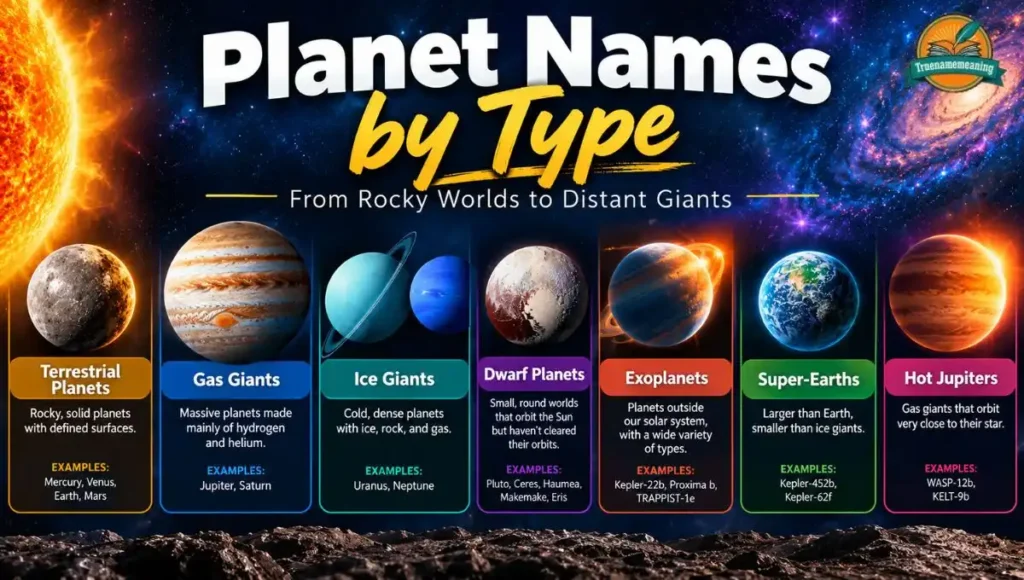
A planet’s environment can guide its name more effectively than random syllables alone. The following planet name ideas are organized by terrain, climate, and broad planetary characteristics, making them useful for maps, worldbuilding notes, and fictional planetary systems.
Ocean World Names
Ocean planets suit stories about aquatic civilizations, deep-sea exploration, floating cities, and mysterious life beneath the waves.
Thalassar, Marenna, Tidalis, Pelagios, Aquavane, Oceandrift, Rivenwave, Coralith, Depthara, Brinevale, Fathomere, Bluehaven, Nerevella, Tidalune, Seafall, Nerithos, Aquorion, Wavecrest, Lumarine, Delphora, Abyssara, Pearlith, Saltmere, Hydralis, Oceanth, and Miralune.
Desert World Names
Desert worlds can feature endless dunes, ancient ruins, mineral-rich canyons, and civilizations built around scarce water.
Arrakeen, Dunestra, Sandveil, Aridara, Scorchane, Solarion, Duskdrift, Cracklands, Bariddesh, Xerathis, Emberdune, Wastelume, Siroccara, Dusthaven, Kharadune, Sunscar, Redmirage, Dryvanta, Cindervast, Mirageon, Sandspire, Thirstfall, Ashdune, Solcrag, and Veyrakh.
Ice World Names
Frozen planets are ideal for isolated research stations, buried alien ruins, dangerous expeditions, and civilizations that survive beneath thick ice.
Hothara, Cryovane, Glacielle, Frostane, Icessia, Permafrix, Kelvindra, Nivaris, Rimefrost, Sleetara, Winterhold, Zerovane, Snowmere, Kryovale, Icefall Prime, Borealis, Shiveron, Glaciron, Tundrath, Frostveil, Polaryn, Nivoria, Coldspire, Ymiris, and Whitehollow.
Volcanic / Fire World Names
Volcanic planets can feature molten landscapes, ash-filled skies, mineral deposits, and extreme heat. Names with fire-associated roots can reinforce these traits.
Mustafara, Ignivane, Pyraxis, Cindervale, Emberon, Flarehold, Magmaris, Scorchveil, Cinderis, Vulcanea, Blazendor, Charrvane, Pyrelith, Lavaxis, Inferna, Ashenor, Caldera Prime, Magmora, Flarion, Brimvex, Ignithor, Sulfara, Embercrag, Fireveil, and Volcaris.
Jungle / Forest World Names
Lush planets are suitable for stories about hidden civilizations, giant plants, ancient temples, unusual wildlife, and ecosystems that resist colonization.
Yavinel, Verdanthe, Vinewild, Canopara, Mossveil, Thornara, Junglara, Palmerune, Rootspire, Sylvantis, Wildreach, Fernholt, Greenhollow, Arborion, Leafara, Verdessa, Briarhaven, Emeraldon, Rainspire, Floravelle, Virewood, Mossara, Canopyth, Sylvarune, and Eldergrove.
Gas Giant Names
Gas giants are enormous worlds dominated by deep atmospheres rather than familiar solid surfaces. Their names can evoke storms, scale, rings, and turbulent skies.
Jovaris, Stormveil, Behemara, Colossane, Vastara, Windroar, Turbulon, Cyclonis, Nimbara, Zephyrion, Tempestra, Grandiveil, Vastrion, Thunderax, Gaseon, Maelstrom, Stormara, Joventhos, Cloudspire, Vortalis, Magnor, Skyrend, Tempestus, Cyclovant, and Nimbus Prime.
Rogue Planet Names (Starless Wanderers)
Rogue planets are not bound to a star in the same way planets orbit their host stars. For fiction, their isolation and drifting journeys make them perfect for mysterious, frozen, or abandoned worlds.
Driftara, Nomadion, Wanderveil, Exilis, Lostworld, Vagravane, Solitude Prime, Unbound, Voidwalker, Strayvane, Orphanis, Umbraveil, Nightdrifter, Starless, Darkroam, Wandross, Veylora, Nullhaven, Duskfarer, Coldwander, Erebon, Farshadow, Blacknomad, Voidmere, and Outrider.
Ring Planet Names
Ring planets need names that suggest grandeur, orbit, and striking celestial architecture. These names can work for gas giants with spectacular rings or fictional rocky worlds surrounded by artificial orbital structures.
Saturnia, Ringveil, Haloran, Coronet, Orbivane, Circlet Prime, Annulus, Diadem, Corolla, Wreathara, Torvane, Encircled, Haloaris, Ringhaven, Orbelis, Crownspire, Circalon, Aurorings, Halo Prime, Vesperring, Orbithane, Asterhalo, Circara, Solcorona, and Grand Circlet.
Planet Names Based on Colors, Elements & Natural Features
Color and elemental themes make planet names easier to visualize. Choose a dominant feature such as copper-colored deserts, violet oceans, crystal mountains, or perpetual storms and build the name around it.
| Theme | Planet name ideas |
| Red planets | Rubrion, Crimsonara, Rusthaven, Scarleton, Redspire |
| Blue planets | Azureth, Cobaltia, Bluemere, Cerulon, Sapphire Reach |
| Green planets | Viridara, Jadeveil, Emeraldon, Mossara, Verdantis |
| Purple planets | Amethystra, Violeth, Purplara, Lilacron, Oriviolet |
| Black planets | Obsidion, Blackstar, Noctyra, Darkmere, Umbrax |
| Golden planets | Aurion, Goldhaven, Gildara, Solgild, Aureovale |
| Crystal worlds | Crystara, Quartzion, Prismvale, Shardara, Geminex |
| Wind worlds | Zephyra, Galeon, Tempestara, Windspire, Aerovex |
| Metal worlds | Ferrion, Cobaltor, Irondara, Steelhaven, Chromara |
| Lightning worlds | Voltaris, Thundara, Sparkion, Stormcrown, Electryx |
For a world with several distinctive features, prioritize one dominant element and use the others in its regional names. A planet called Azureth could contain the Glass Desert, the Stormbelt Sea, and the Obsidian Highlands.
Sci-Fi Planet Name ideas for Space Exploration & Futuristic Stories
Science fiction planet names should suit the technology, political structure, and exploration style of your setting. A remote colony might have a practical designation, while a planet at the center of an interstellar empire could carry a ceremonial name.
Here are 30 futuristic planet name ideas:
- Nexora
- Axion Prime
- Veltrix
- Orbinara
- Quantaris
- Cygnara
- Starforge
- Novexis
- Heliox
- Xenovant
- Keplerion
- Astravex
- Galactra
- Omnaris
- Zenith-9
- Exovale
- Cryptron
- Vectara
- Solstice Prime
- Neutravia
- Hyperion Gate
- Quantum Reach
- Polaris Nova
- Xenithra
- Voidstation
- Stellarion
- Andromara
- Cosmovex
- Intera Prime
- Lumetrix
For a more scientifically grounded setting, combine a host-star catalog identifier with a planet letter, such as KX-204 b. This is a fictional example, not an actual astronomical designation. The IAU explains that exoplanets commonly receive scientific designations tied to their host stars, while public names may be adopted through dedicated naming initiatives.
Read More: 350+ Funny Fortnite Names That’ll Make Your Squad Laugh
Planet Naming Mistakes to Avoid When Creating a Fictional World
A memorable name should support the world rather than distract readers from it. Avoiding a few common mistakes can make your fictional planetary system more coherent and easier to follow.
- Choosing names that sound too similar: Vexara, Vexaris, and Vexarion may become confusing when they appear in the same chapter.
- Using random letters without a pattern: A few unusual sounds can make a name alien, but excessive punctuation or consonant clusters can make it difficult to pronounce.
- Ignoring the setting’s culture: A planet named by an ancient ocean-dwelling civilization might have a different naming tradition from one designated by a modern space agency.
- Giving every name an exaggerated meaning: Not every planet needs a title such as “World of Eternal Fire.” Sometimes a simple name feels more authentic.
- Borrowing famous fictional names without considering originality: Names strongly associated with established franchises can confuse audiences and create intellectual-property concerns.
- Mixing naming systems without explanation: If some planets use Roman gods and others use invented syllables, give the difference a reason, such as different languages or historical periods.
- Forgetting the wider planetary system: A planet, its moons, its star, and its neighboring worlds should have names that make sense together.
A useful final check is to read your planet names in a list, speak them aloud, and see whether you can distinguish each one without looking. For commercial projects, also check existing astronomical names, fictional franchises, and relevant trademarks.
Twin & Binary Planet Names
Twin planets and binary planetary systems benefit from names that sound connected without being identical. Use pairs based on opposites, shared mythology, complementary environments, or a common language.
| Planet pair | Theme |
| Sol and Luna | Sun and Moon imagery |
| Ignis and Glacia | Fire and ice |
| Dawn and Dusk | Opposite ends of the day |
| Umbra and Lumen | Shadow and light |
| Thera and Thanis | Invented names with a shared sound |
| Ember and Frost | Heat and cold |
| Auralis and Noctaris | Brightness and darkness |
| Verdara and Aridia | Lush landscapes and dry deserts |
| Astra and Vesper | Stars and evening |
| Caelum and Terra | Sky and Earth associations |
| Elarion and Velarion | Related invented names |
| Solara and Lunara | Solar and lunar imagery |
| Storm and Still | Turbulence and calm |
| Miravel and Coravel | Complementary invented names |
| Pyra and Niva | Fire and snow imagery |
| Aurum and Argent | Gold and silver |
| Haven and Exile | Safety and isolation |
| Nova and Nox | Newness and night imagery |
| Oceanus and Terralis | Water and land |
| Zephra and Boreas | Wind-inspired names |
If your story includes two planets orbiting a shared center of mass, distinguish that physical arrangement from a simple pair of neighboring planets. The names can be poetic, but the astronomy should match the world you are creating.
Moon Names
Moon names work best when they connect to the parent planet’s mythology, local culture, environment, or scientific classification. A moon may be a natural satellite, an inhabited frontier, or an artificial installation in a science fiction story.
- Mythological: Io, Selene Minor, Titanix, Callindra, Ganymere, Europani, Enceladine, Mimasara.
- Mysterious: Charonis, Phobetor, Deimara, Umbriel II, Ariel Minor, Nereidon, Larissane, Despina Minor.
- Beautiful: Galatea II, Proteusar, Lunessa, Auralune, Silvaris, Moonveil, Celestine, Elarune.
- Hostile: Cragmoon, Ashenrock, Ironhollow, Grimora, Shatterfall, Vexmoon, Blackcrater, Stormscar.
- Alien: Qelthari, Xyrom, Vraxune, Thal’qir, Zorvella, Krynthos, Uxalara, Nymvex.
- Habitable: Havenmoon, Greenreach, New Selene, Lumarra, Edenfall, Silverhaven, Clearwater, Dawnmere.
For extra worldbuilding depth, give each moon a different role. One could support a mining colony, another could house a research facility, and a third might be forbidden because of its unusual atmosphere or ancient ruins.
Beautiful & Gleaming Planet Names
Beautiful planet names often use flowing syllables, light-related imagery, and sounds associated with calm or wonder. These are especially useful for paradise worlds, advanced civilizations, enchanted planets, and peaceful destinations.
Luminae, Aurelia, Celestine, Glimmerath, Radiantis, Opaline, Prismara, Iridessa, Halcyona, Serenova, Lucenne, Solarielle, Elaria, Auravelle, Luminara, Asterelle, Miralune, Veloria, Elowen, Caeloria, Dawnlily, Solenne, Opalith, Starbloom, and Everglow.
For a world with glowing oceans, try Luminara or Miralune. For a planet famous for golden cities, Aurelia or Auravelle may fit better. If the beauty conceals a dangerous secret, a name such as Halcyona can create an interesting contrast between appearance and reality.
Weird & Funny Planet Names
Funny planet names are ideal for comedy science fiction, parody games, and lighthearted campaigns. They can be deliberately silly, based on puns, or inspired by ordinary objects that seem ridiculous on a cosmic scale.
Zorpalot, Blorgon-9, Snackworld, Wigglenax, Poot IV, Doofalax, Yeetaris, Blipzoid, Sploosh Prime, Gribblenar, Wobbleon, Meh-tron, Uh-Ohia, Nopeplanet, Chunkasaurus, Fluffonia, Grumpton, Snorlaxia, Potato Prime, Noodleon, Pickleverse, Bananara, Gooforia, Bloopiter, Quackton, Sir Barksalot, Fizzbang, Waffleworld, Booparis, and Planet Oops.
More pun-based ideas include Procrasti-Nation, Planetary McPlanetface, Asteroid Adjacent, Snacktoria, and The Big Snooze. These are intentionally humorous rather than realistic astronomical names, so use them when the tone suits your setting.
Cute Planet Names
Cute planet names can make imaginary worlds feel friendly, cozy, and inviting. They are particularly useful for children’s stories, casual games, adorable alien civilizations, and colorful illustrated universes.
Puffara, Bubblewick, Cloudessa, Dewdropia, Fuzzball Prime, Glowbug, Honeyvane, Jellybelle, Kittenworld, Lullaby Sphere, Marshmallowe, Nectarine Prime, Pebblepop, Twinkleton, Cuddlevia, Pippinara, Sugarplum, Doodlemoon, Puddlewick, Blossomara, Mallowmere, Snuggleon, Buttercupia, Little Star, Peachora, Berribelle, Cozyvale, Gigglewick, Starpuff, and Pompom Prime.
For a cohesive collection, pair these planets with cute moon names such as Button, Tinkerbell, Pip, Dottie, or Mallow. A shared naming style helps a fictional universe feel intentional rather than randomly assembled.
Dark & Ominous Planet Names
Dark planet names work well for abandoned colonies, cursed worlds, hostile empires, and planets where survival is uncertain. Hard consonants and words associated with shadows, ruins, and isolation can create a foreboding impression.
Malvorath, Grimspire, Voidmaw, Thanaris, Necrovane, Doomhaven, Blightara, Shadowreach, Corvexis, Direwake, Perdition Prime, Krethgul, Nightfall, Dreadmere, Blackthorn, Vanthex, Ashenveil, Graveworld, Noctharis, Ruinspire, Morvex, Netherion, Doomstar, Hollowreach, Darkhaven, Vilethra, Umbrafell, Gloomara, Wraithborne, and Oblivara.
For a planet ruled by a ruthless empire, Malvorath or Vanthex may sound imposing. For a world abandoned after a catastrophe, Hollowreach or Ruinspire could suggest a more tragic history. A name creates the first impression, while the setting itself should explain what makes the world dangerous.
Famous Fictional Planets & What Makes Their Names Work
Famous fictional planets offer useful lessons in naming, but their names should be treated as examples rather than templates to copy. Some draw on real languages or mythology, while others create a distinctive identity through sound and cultural context.
| Fictional planet | Franchise | Naming insight |
| Tatooine | Star Wars | A distinctive name associated with a desert world and a real-world place-name inspiration |
| Arrakis | Dune | A sharp, memorable name closely tied to the story’s harsh desert setting |
| Krypton | Superman | A concise name with a classical-sounding, science-fiction identity |
| Pandora | Avatar | Uses Greek mythology to suggest wonder mixed with danger |
| Vulcan | Star Trek | Draws on the Roman god of fire |
| Gallifrey | Doctor Who | An invented name that helps distinguish an unfamiliar civilization |
| Naboo | Star Wars | Short, smooth sounds fit its recognizable identity |
| Coruscant | Star Wars | Associated with the Latin word coruscare, meaning to glitter or gleam |
These examples illustrate different strategies: mythological associations, evocative sound, concise naming, and connections between a name and a world’s identity. You can use those general techniques to create original planet names without copying recognizable franchise names.
Planet Names for D&D & RPGs
Planet names for Dungeons & Dragons and other role-playing games should be memorable when spoken aloud, distinctive on a campaign map, and flexible enough to support future adventures. Consider how the name sounds when a game master announces it, or players discuss it repeatedly.
Toril Beyond, Krynnos, Oerthara, Athasvane, Ravenspire World, Sigil’s Reach, Faerunis, Wildspace Prime, Astralore, Ethervane, Mythrandor, Netherworld IX, Eldritch Vale, Dragonfall, Starweald, Runebreak, Obsidian Reach, Mythspire, Aetherhold, Spellhaven, Wyrmrest, Shadowmere, Arcaneon, Feywild Prime, Dreadspire, Crystal Bastion, Celestara, Voidmarch, Stormkeep, and Emberwatch.
For a campaign with several planets, establish a few naming rules. Kingdoms might use older names, explorers may assign practical designations, and ancient civilizations may leave names that modern inhabitants no longer understand. This approach gives the setting a sense of history and helps players remember its locations.
Galaxy & Star System Names
Galaxy and star system names should suggest a scale larger than an individual planet. Words such as expanse, cluster, reach, arm, and nebula can help readers distinguish a single world from a larger region of space.
- Star systems: Kaldross System, Novastra System, Solmere System, Threxos System, Aurelian System, Veyrion System.
- Galaxies: Voidreach Galaxy, Meridian Galaxy, Astralis Galaxy, Wraithspire Galaxy, Celestara Galaxy, Umbralion Galaxy.
- Clusters: Thessaly Cluster, Threxos Cluster, Orion’s Crown Cluster, Velorian Cluster, Starfall Cluster, Aetherion Cluster.
- Nebulae: Astralis Nebula, Emberveil Nebula, Crystal Mist Nebula, Violet Shroud Nebula, Phoenix Veil Nebula, Luminous Rift Nebula.
- Space regions: The Aurelian Expanse, The Meridian Arm, The Wraithspire Belt, The Ossian Reaches, The Umbral Sea, The Outer Silence.
- Frontier territories: Farstar Reach, The Uncharted Verge, The Silent Frontier, The Broken Meridian, The Last Horizon, The Forgotten Arm.
You can also use a consistent structure, such as naming systems after stars, clusters after constellations, and frontier regions after explorers or historical events. These conventions make a large fictional map easier to navigate.
Read More: BEST Funny Steam Names 2026 Edition
How to Choose the Perfect Planet Name ideas
The right planet name should fit the story, remain easy to remember, and give readers a reason to imagine the world behind it. Use these four tips to narrow down your planet name ideas and choose one that fits your fictional universe.
Tip 1: Match the Name to the World’s Function in Your Story
Think about what the planet does in your narrative. A homeworld may need a familiar, foundational name, while a forbidden planet might benefit from something unsettling.
For example, Havenora could suit a peaceful settlement, Kharvex a hostile frontier, and Aurelia a prosperous capital. These associations are creative suggestions, so your story can always subvert the first impression.
Tip 2: Build a Consistent Naming System Across Your Universe
Decide whether names come from mythology, a fictional language, scientific cataloging, or a combination of these approaches. If planets were named by different civilizations, their naming differences can become part of the world’s history.
For example, an ancient civilization might use names such as Elarion and Veloria, while a modern exploration agency records planets as NX-41 b and NX-41 c. Both systems can coexist naturally when the setting explains their origins.
Tip 3: Consider How the Name Sounds in Dialogue
A planet name should be comfortable to say repeatedly in dialogue, narration, and gameplay. Test it in sentences such as “We’re three jumps from Kelvara Prime” or “The last transmission came from Veyrion.”
If the name is difficult to remember, simplify it or give it a shorter nickname. A planet might officially be called Thalorath IV but be known to its inhabitants simply as Thalor.
Tip 4: Don’t Over-Explain the Name
A strong planet name ideas can create curiosity without describing every feature of the world. Nightveil might suggest a dark planet, but readers should discover whether its darkness comes from a thick atmosphere, a distant orbit, or an artificial shield.
Reserve descriptive names for places where clarity matters more than mystery. A straightforward name such as New Horizon Station may be perfect for a colony, while an ancient world can carry a more cryptic name such as Orynth.
FAQs
What is a good name for a fictional planet?
A good fictional planet name is memorable, easy to pronounce, and suited to the world’s environment or history. Names such as Aurelia, Veyrion, Kharvex, and Elaria offer different styles for peaceful, futuristic, or mysterious settings.
What are some cool planet names?
Cool planet names include Kryonis, Draxis, Voss, Zenar, Kaldeth, and Stormrax. Short names with distinctive sounds often work well in science fiction novels, games, and space exploration stories.
How do I create unique planet name ideas?
Start with the planet’s defining trait, choose a meaningful or invented root, and add an ending that fits your naming style. Then check pronunciation, consistency with neighboring planet names, and similarities to existing fictional or astronomical names.
What are good names for alien planets?
Good alien planet names include Xar’thul, Q’renna, Zorathix, Vranthex, and Krynthos. For greater realism, establish recurring sounds and naming patterns that reflect the alien civilization’s language.
What are the best fantasy planet name ideas for worldbuilding?
Fantasy planet names such as Aelindor, Sylvaneth, Crystalreach, Moonrealm, and Everdawn suit magical worlds and mythical civilizations. Choose names that complement your setting’s themes, geography, and cultural history.
Can I use mythology to name a fictional planet?
Yes, mythology can inspire planet names through gods, legendary creatures, and cosmological concepts. Research the original meaning and cultural context, especially when drawing from traditions that are unfamiliar to you.
Is there an official planet name generator?
There is no single universal official generator for naming fictional planets, but you can use a planet name generator or combine roots, suffixes, and environmental themes yourself.
Conclusion
The best planet name ideas combine a distinctive sound with a clear purpose in your fictional universe. Whether you need an icy frontier, a magical realm, a hostile alien world, or a peaceful colony, start with the planet’s defining traits and build a name that fits its identity.
Use the lists in this guide as inspiration, then adapt the strongest ideas to your setting’s languages, mythology, and history. A thoughtful naming system will make your planets easier to remember and help your worldbuilding feel more cohesive.
A planet name is the beginning of a world’s identity. Choose one that makes your readers curious about what lies beyond the name itself.

I’m M Umair, the author behind True Name Meaning. I have experience researching names, their origins, meanings, history, and biblical significance. I focus on reliable information and simple explanations to help readers discover the true meaning and story behind every name.